Yekaterinburg
Yekaterinburg
Yekaterinburg, capital of the Urals, blends Romanov heritage, Soviet constructivist architecture and contemporary museums. A historic crossroads between Europe and Asia, a key stop on the Trans-Siberian railway.
Yekaterinburg is Russia's fourth-largest city, capital of the Urals, positioned precisely on the Europe-Asia border. Founded in 1723 by Peter the Great as a metallurgical center, it is best known as the place where the Imperial Romanov family was executed in 1918. Today, it is a dynamic metropolis rich in museums, Soviet constructivist architecture and historical memorials that make it a major stop on the Trans-Siberian railway.
Practical information at a glance
- Access: Koltsovo international airport, served from Moscow and Saint Petersburg; central railway station on the Trans-Siberian line.
- Urban transport: metro (one line), trams, buses and taxis.
- Recommended duration: 2 to 3 days to cover the main sites.
- Time zone: UTC+5 (Yekaterinburg time).
- Dress code: covered clothing required in churches and monasteries.
What to see
The city concentrates several historical layers visible in the public space. The historic center runs along the Iset River with its 18th-century buildings. Constructivist architecture from the 1920s-1930s is particularly dense: buildings on 1905 Square, former workers' clubs, converted factories. The museums cover the history of the Urals, the arts, geology and Romanov remembrance.
History and context
Founded in 1723 under Peter the Great, Yekaterinburg takes its name from Catherine I. It quickly became the center of Ural metallurgy. In July 1918, Tsar Nicholas II, his wife Alexandra and their five children were shot by Bolsheviks in the Ipatiev House. The city was called Sverdlovsk from 1924 to 1991, in honor of revolutionary Iakov Sverdlov. Boris Yeltsin, the first president of post-Soviet Russie, was born there and began his political career there.
Highlights of your visit
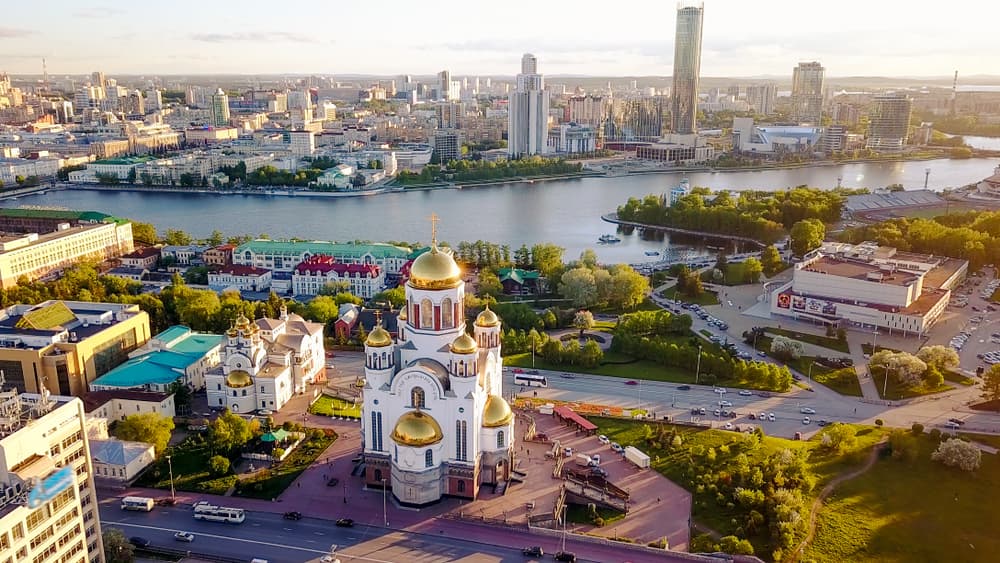
Church on the Blood
Built between 2000 and 2003 at the exact location of the Ipatiev House, this five-domed golden Orthodox church commemorates the execution of the Romanovs. The interior houses frescoes depicting the life and martyrdom of the imperial family, canonized by the Russian Orthodox Church in 2000.
Ganina Yama Monastery
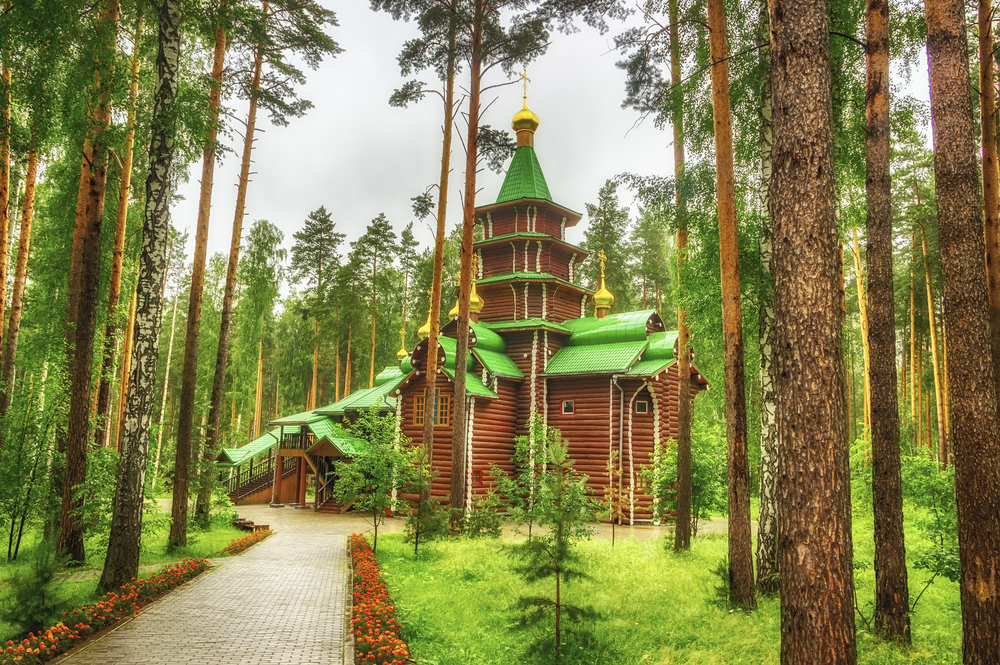
About twenty kilometers from the center, this monastic complex marks the site where the Romanovs' bodies were thrown into an abandoned mine. Seven wooden chapels, one for each family member, surround the original well in a birch forest.
Museum of the History of the Urals
This museum traces the region's history from prehistory to the Soviet era, with particular attention to the mining and metallurgical industry that shaped the Urals. The collections of local minerals and semi-precious stones are remarkable.
Europe-Asia Border
An obelisk located about forty kilometers west of the city symbolically marks the dividing line between the two continents. A second, more recent monument can be found in the immediate vicinity of the city, accessible by taxi or organized excursion.
Yeltsin Center
Opened in 2015, this museum-memorial dedicated to Boris Yeltsin is one of Russia's most modern museums. It traces the end of the Soviet era and the 1990s through interactive installations and audiovisual archives.
Photography tips
The Church on the Blood is most photogenic in late afternoon, when golden light strikes the domes. Ganina Yama monastery offers beautiful forest compositions, especially at sunrise or in autumn with golden birches. The constructivist architecture of the center photographs well in early morning raking light. Photography is generally allowed outside places of worship; inside, check the rules posted on-site.
Etiquette and visiting rules
- In churches and the monastery: shoulders and knees covered, headscarf for women.
- Silence and reverent behavior in prayer spaces.
- Photography inside places of worship: often prohibited or subject to authorization — check on-site.
- At Ganina Yama monastery, respect the sacred character of the site; avoid casual clothing.
Location and access
Yekaterinburg is located in the oblast of the same name, at the eastern foot of the Urals. The central station is a major hub on the Trans-Siberian line, approximately 26 hours by train from Moscow. Koltsovo airport offers direct flights from major Russian cities. The metro serves central neighborhoods; peripheral sites such as Ganina Yama require a taxi or organized excursion.
Nearby
- Ganina Yama Monastery — complex of seven wooden chapels in the forest, on the site of the Romanovs' final resting place.
- Europe-Asia Obelisk — symbolic monument marking the border between the two continents, west of the city.
- Taganay National Park — Southern Urals massif accessible from Zlatoust, ideal for hiking in natural surroundings.
Frequently asked questions
From May to September, temperatures are pleasant (10-25 °C). Summer is short but sunny. Winter is harsh (down to -20 °C), but the city remains lively and snow-covered landscapes have their charm.
The monastery is about twenty kilometers from the center. A taxi or organized excursion through a local agency is the most practical solution. Some suburban buses serve the area, but check schedules on-site.
Most European nationals require a Russian visa. Entry conditions change regularly; consult the Russian embassy or your ministry of foreign affairs before planning your trip.
The church is open to visitors outside religious services. Admission is generally free. Covered clothing is required; shawls are sometimes available at the entrance.
Yes. The city is a natural stop on the Trans-Siberian route between Moscow and Siberia (Novosibirsk, Irkutsk). It combines well with Kazan, about 7 hours by train to the west.
Two days allow you to cover the Church on the Blood, the Yeltsin Center, the Museum of the History of the Urals and a half-day at Ganina Yama. Three days offer a more comfortable pace and allow you to explore constructivist architecture.
Interested in this visit?
We can include it in your personalised itinerary.