Ganina Yama
Ganina Yama
Located 20 km north of Yekaterinburg, Ganina Yama is the Orthodox monastery built around the pit where the bodies of Tsar Nicholas II and his family were concealed in 1918. Seven wooden churches, a pine forest, and an atmosphere of contemplation unlike any other.
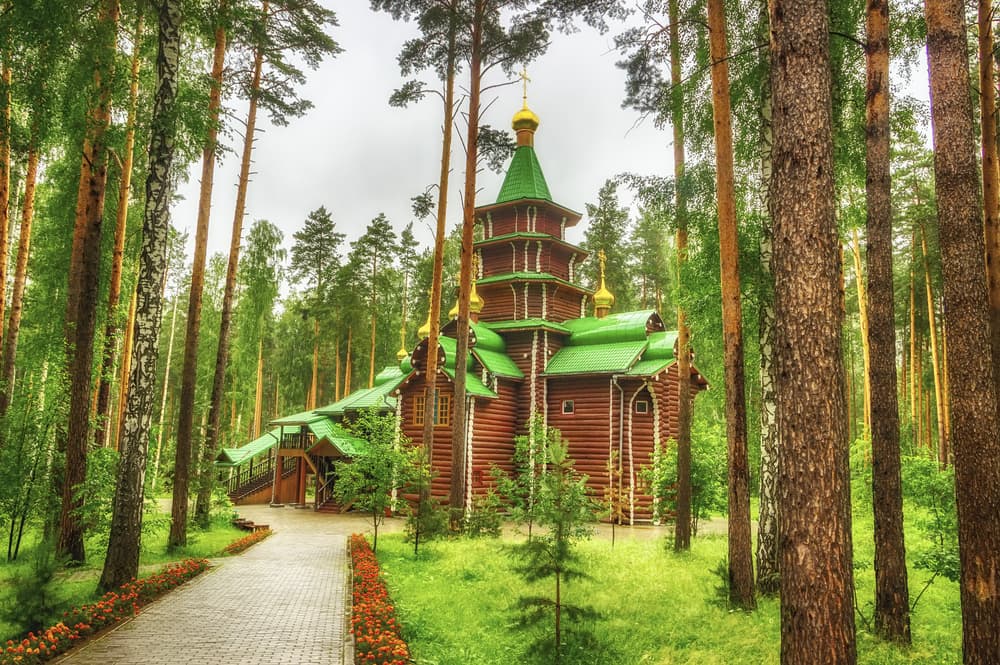
Ganina Yama is an Orthodox monastery set within a pine forest about twenty kilometers north of Yekaterinburg. The site marks the location where the bodies of Tsar Nicholas II and his family were cast into an abandoned mine in July 1918, following their execution. Today, seven wooden churches surround the pit, transforming this place of tragedy into a space of remembrance and spiritual reflection.
Practical Information at a Glance
- Admission: free
- Access: by car from Yekaterinburg (Serov road) or organized bus tour from the city
- Recommended duration: 1 hour 30 minutes to 2 hours to explore the entire complex
- Dress code: covered head and shoulders for women; no shorts for men inside the churches
- Accessibility: forest paths are partly unpaved; wheelchair access is difficult
What to See
The heart of the site is the pit itself, surrounded by a wooden fence and votive crosses. Seven small churches built from larch logs were constructed between 2000 and 2004, each dedicated to a member of the imperial family. Icons, candles, and flowers accumulate continuously around the pit. A pathway lined with crosses connects the various buildings through the forest.
History and Context
During the night of July 16–17, 1918, Tsar Nicholas II, Empress Alexandra, their five children, and four servants were executed in the Ipatiev House in Yekaterinburg. Their bodies were transported to Ganina Yama and cast into a mine shaft. In 2000, the Russian Orthodox Church canonized the imperial family. The monastery of the Holy Royal Martyrs was founded on this site the same year.
Highlights of the Visit
The Pit and Votive Crosses
The original, shallow pit is visible behind a wooden fence. Hundreds of crosses and icons left by pilgrims create an atmosphere of intense reflection. This is the focal point of the entire site.
The Seven Wooden Churches
Each church is dedicated to one of the martyred Romanovs. The sober log architecture, typical of Russian tradition, integrates naturally into the pine forest. The interior of each chapel is adorned with icons and recent frescoes.
The Path of Crosses
A processional path connects the buildings. Wooden crosses planted by pilgrims from across Russia and abroad line the route. Walking through the pines gives the place a contemplative quality.
Etiquette and Visiting Rules
- Silence and respectful behavior required at all times — the site is an active place of worship.
- Women must cover their head and shoulders before entering the churches.
- Men should avoid wearing shorts inside the chapels.
- Do not touch the offerings, crosses, or icons left by pilgrims.
- Religious services take place regularly; adjust your visit to avoid disturbing them.
Photography Tips
The light filtered through the pines is particularly beautiful in the morning. The wooden churches photograph well with a slight upward angle to include the canopy. Inside the chapels, check with the monks if photography is permitted — some do not allow it. The pit itself: photograph discreetly and without flash.
Location and Access
Ganina Yama is located in the Yekaterinburg region of the Urals. From the city center, allow approximately 20 to 25 km heading north toward Serov. Most visitors arrive by car or through organized tours from Yekaterinburg. The site is often combined with a visit to the Church on the Blood, built in Yekaterinburg at the location of the Ipatiev House where the family was executed.
Nearby Attractions
- Church on the Blood (Temple-on-the-Blood) — a monumental Orthodox cathedral erected at the very site of the Romanovs' execution, in Yekaterinburg.
- Yekaterinburg History Museum — traces the city's history from its founding in the 18th century through the Soviet era.
- Europe-Asia Border Marker — a symbolic monument marking the boundary between the two continents, a few kilometers from Yekaterinburg.
Frequently asked questions
The monastery is accessible throughout the year. In winter, the snow-covered forest enhances the atmosphere of the place, though paths can be slippery.
Yes. Women must cover their head and shoulders inside the churches. Men should avoid wearing shorts. Bring a scarf or shawl.
Yes, this is the most common combination. The two sites form a complete memorial circuit about the end of the Romanovs. Allow a full day for both.
Local agencies in Yekaterinburg offer guided excursions including Ganina Yama. The site itself does not have a permanent official guide service.
It is generally permitted outdoors. Inside the chapels, ask the monks present for permission before photographing.
The most practical solution is an organized tour from Yekaterinburg. There is no regular public transportation service directly to the monastery.

Interested in this visit?
We can include it in your personalised itinerary.