New Tretyakov Gallery (Krymsky Val Building)
New Tretyakov Gallery (Krymsky Val Building)
On Krymsky Val embankment in Moscow, the New Tretyakov Gallery (1985) houses the world's largest collection of 20th-century Russian art: avant-garde, Malevich, Kandinsky, and socialist realism under one roof.
Along Krymsky Val embankment, facing Gorky Park, the New Tretyakov Gallery holds the world's largest collection of 20th-century Russian art. Built in 1985 in late Soviet style, it complements the historic Lavrushinsky Pereulok building by covering the avant-garde, socialist realism, and contemporary art. This is where you'll find works by Kandinsky, Malevich, Chagall, and Rodchenko—a unique panorama of Russian modernity.
Practical information at a glance
- Admission: paid (discounts for students and retirees); free on the third Sunday of the month for Russian citizens
- Recommended duration: 2 to 3 hours for permanent collections
- Access: metro line 5 (Oktyabrskaya), exit toward Gorky Park—a few minutes on foot
- Dress code: no restrictions
- Photography: permitted in permanent collections without flash or tripod; some temporary exhibitions prohibit it
- Accessibility: elevators and ramps available in the main building
What to see
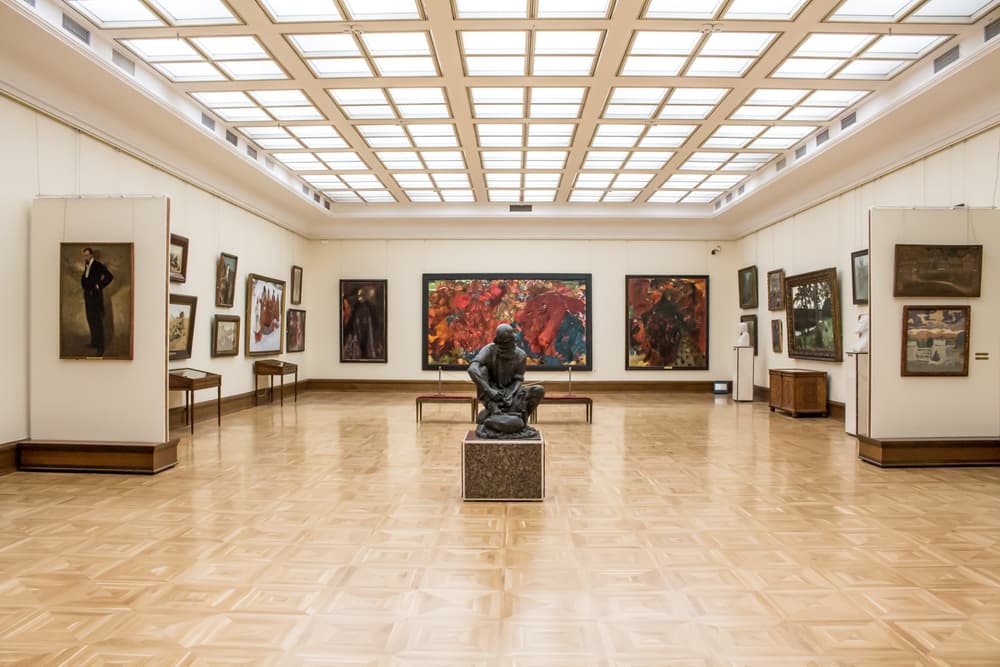
The permanent collections span Russian art from 1900 to the present, distributed across several floors. The heart of the tour focuses on the avant-garde of the 1910s–1930s: Malevich's suprematism, Rodchenko's constructivism, Kandinsky's abstract compositions. The following galleries document socialist realism under Stalin, then Soviet unofficial art of the 1960s–1980s.
History and context
The Tretyakov Gallery was founded in 1856 by merchant Pavel Tretyakov, who bequeathed his collection to Moscow in 1892. Faced with an influx of modern works in the 20th century, a second building was constructed on Krymsky Val and opened in 1985. It now houses all art after 1900, while the historic Lavrushinsky Pereulok building preserves ancient and 19th-century Russian art.
Highlights of the visit
Russian avant-garde
Malevich's Black Square (1915) is displayed here in its definitive version. Surrounding it, canvases by Popova, Lissitzky, and Tatlin recreate the creative ferment of this era. These galleries constitute one of the world's finest documented avant-garde ensembles.
Kandinsky and abstraction
Several major compositions by Wassily Kandinsky punctuate the tour, tracing his evolution from Munich to Paris. The restrained presentation of the galleries lets the works speak without curatorial excess.
Socialist realism
Often overlooked abroad, this monumental collection reveals Soviet visual propaganda in all its technical mastery. The large-scale works of Alexandr Deineka and Yuri Pimenov offer a striking historical counterpoint to the neighboring avant-garde.
Temporary exhibitions
The building regularly hosts major international retrospectives. The program changes several times a year; check the official website calendar before your visit.
Photography tips
Natural light is sparse in the interior galleries—favor a high ISO setting without flash. The exterior of the building, with its concrete façade and views over Gorky Park, photographs well in late afternoon. Check restrictions specific to each temporary exhibition at the entrance.
Location and access
The museum stands on Krymsky Val in the Yakimanka district, along the edge of Gorky Park. Oktyabrskaya station (lines 5 and 6) is the nearest metro stop. The Museum of Modern Art in Moscow and the historic Tretyakov Gallery building at Lavrushinsky Pereulok naturally complement the visit. English-speaking guided tours are offered by select local agencies partnering with Nomadays.
In the surroundings
- Gorky Park — iconic urban park just across the street, ideal for a break after your visit.
- Historic Tretyakov Gallery — the original building preserves Russian art from the 9th to 19th centuries, a few minutes by metro.
- Museum of Modern Art Moscow (MMOMA) — another hub of contemporary Russian art, downtown.
- Christ the Savior Cathedral — a short walk along the Moskva River.
Frequently asked questions
The historic building at Lavrushinsky Pereulok presents Russian art from the Middle Ages to the early 20th century. The Krymsky Val building (1985) covers modern and contemporary art from 1900 onward. Both sites share the same institutional name.
Photography without flash or tripod is permitted in the permanent collections. Some temporary exhibitions prohibit it entirely; a pictogram at the entrance of each gallery indicates this.
Plan for 2 to 3 hours to tour the permanent collections at a leisurely pace. If a major temporary exhibition is on, allow a full half-day.
The park is directly accessible from the museum entrance. A morning museum visit followed by lunch in the park makes for a coherent and pleasant day, especially in spring and summer.
The museum offers audioguides in several languages. English-speaking guided tours are organized by partner local agencies; contact Nomadays to arrange one.
The museum is open year-round. Major autumn and winter retrospectives draw larger crowds; weekday mornings offer quieter galleries.
Interested in this visit?
We can include it in your personalised itinerary.