Stalin's Bunker (Objekt 42)
Stalin's Bunker (Objekt 42)
Buried more than 37 meters below Samara, Objekt 42 is the secret bunker built for Stalin in 1942, which remained classified until 1990. A unique museum dedicated to Russia at war.
Buried more than 37 meters beneath the center of Samara, Objekt 42 is the nuclear bunker secretly constructed between 1942 and 1942 to shelter Stalin in case of German invasion. The Soviet leader never stayed there, but the facility remained classified until 1990. Today converted into a museum, it is one of the rare World War II bunkers accessible to the public in Russie.
Practical info at a glance
- Admission : paid entry (museum rates vary depending on guided or self-guided tour)
- Access : downtown Samara, near Frunze Street
- Recommended duration : 1.5 to 2 hours for a full guided tour
- Guided tour : highly recommended — much of the site is only accessible with a guide
- Attire : closed-toe shoes recommended (metal stairs, damp floors in places)
What you'll see
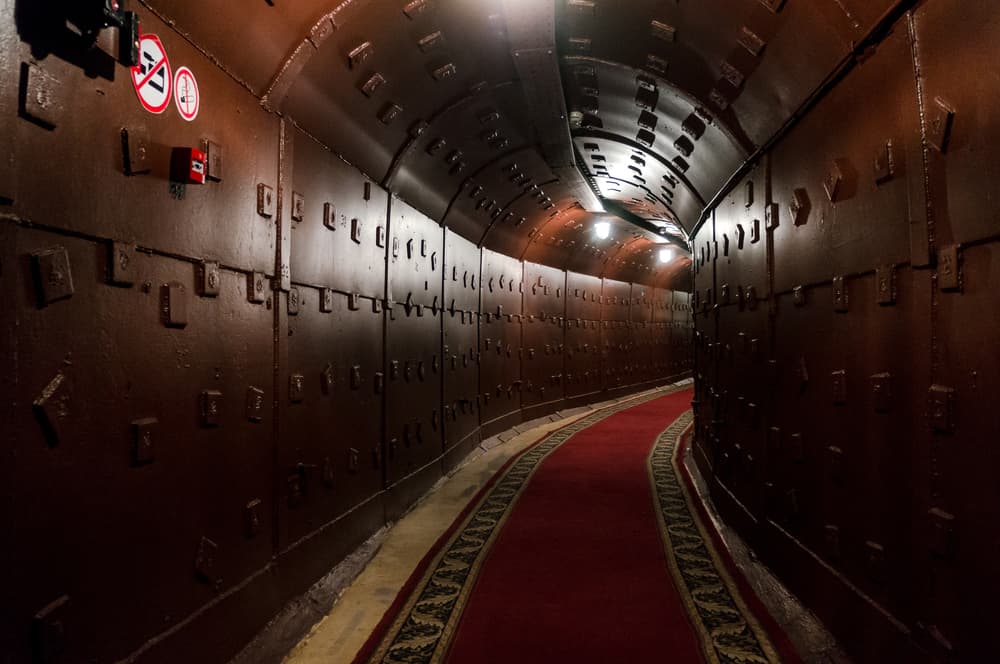
The descent is made by a staircase spanning several dozen meters leading to a network of corridors and rooms carved into clay. You will discover the reconstructed conference room where Stalin could have directed operations, period communication equipment, ventilation and filtration systems, as well as exhibitions on the Battle of Stalingrad and the strategic role of Samara — then renamed Kuibyshev — during the war.
History and context
In 1941, faced with German advances, Moscow was at risk of falling. Kuibyshev (Samara) was designated as a backup capital: foreign embassies, ministries, and strategic industries were evacuated there. The bunker, built by the NKVD in record time, was meant to ensure the survival of supreme command. Its depth — comparable to a twelve-story building — made it resistant to bombs of the era. Its existence was only officially acknowledged after the collapse of the USSR.
Highlights of the visit
Stalin's conference room
Reconstructed with period furniture and maps, this central room illustrates the command system that was planned. The confined atmosphere and artificial lighting reinforce the sense of isolation intended by the designers.
Technical systems
Autonomous ventilation, anti-gas filters, independent electrical generators: Soviet engineering from the 1940s is displayed in its original or near-original state, with explanations of how it functioned in case of chemical or aerial attack.
The exhibition on wartime Kuibyshev
Documents, photographs, and objects trace the city's role as a shadow capital: military parade of November 7, 1941 organized here in parallel with Moscow's, presence of diplomatic corps, wartime industrial production.
Photography tips
Lighting is entirely artificial and dim in most corridors. A fast lens or high ISO sensitivity is essential. Flashes are generally tolerated but check with your guide. The reconstructed rooms offer the best angles; the technical corridors provide a more raw atmosphere.
Location and access
The bunker is located in the historic center of Samara, not far from the Volga. The city is accessible from Moscow by plane (approximately 1 hour) or overnight train. From the center, the site is accessible on foot or by public transport. Entry to the bunker involves descending a long staircase: accessibility for those with mobility issues is very limited.
Nearby attractions
- Volga Embankment — iconic promenade along the river, just a few minutes' walk away.
- Samara Regional Museum — collections on local history and the Soviet period.
- Stalin's House in Samara — preserved dacha where the leader stayed briefly, another vestige of the war period.
Frequently asked questions
Booking is recommended, especially during high summer season and for groups. Guided tours depart at set times; contact the museum directly for available time slots.
The site is accessible to children from a certain age, but the descent is long and confined spaces can be intimidating for younger visitors. Check for any age restrictions at the ticket office.
Closed-toe and stable shoes are essential for the metal stairs. The temperature in the bunker is cool year-round: bring an extra layer even in summer.
Part of the site is accessible for self-guided visits, but the deepest areas and reconstructed rooms are only explored with a guide. A guided tour is highly recommended to understand the historical context.
The bunker can be visited year-round, as the interior temperature remains constant. To combine it with a stroll along the Volga, the months from May to September offer the best outdoor conditions.
Interested in this visit?
We can include it in your personalised itinerary.