Alexander Garden
Alexander Garden
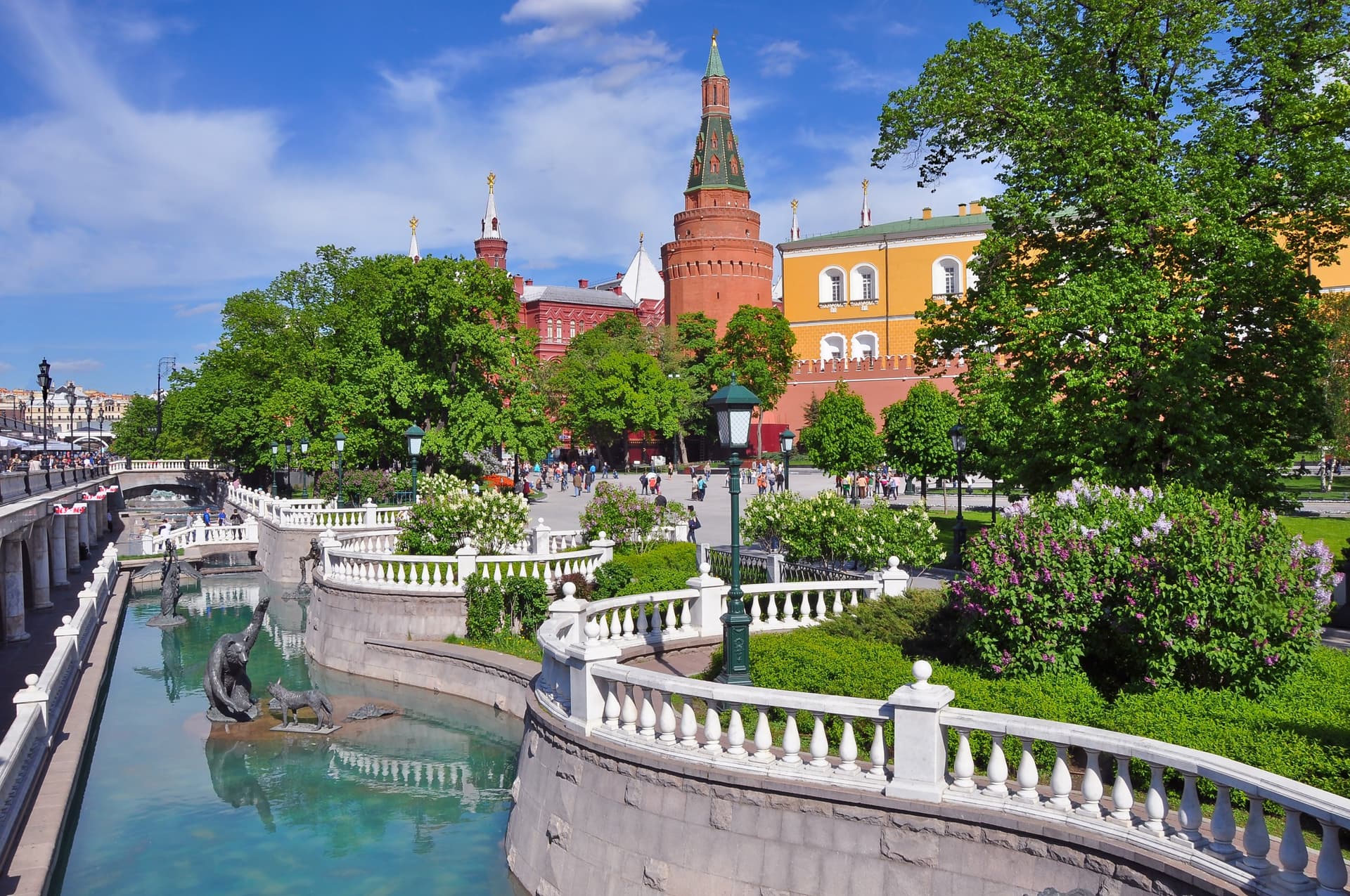
Moscow's first public park, Alexander Garden runs along the Kremlin wall and is home to the Tomb of the Unknown Soldier, the Romanov tricentenary obelisk, and the Tsereteli fountains.
Alexander Garden stretches at the foot of the Kremlin's northwestern wall, between Red Square and the palace fortifications. Laid out in the early 19th century to celebrate Russian victory over Napoleon, this Moscow urban park combines historical memory, monumental fountains, and tree-lined promenades along the former course of a river now underground.
Why visit Alexander Garden
Moscow's first public park, the garden offers a verdant respite between two of the capital's most visited sites. A visit fits naturally into a tour around the Kremlin and Red Square, requiring no detours. Within its boundaries stand several key monuments of Russian history: the Tomb of the Unknown Soldier with its eternal flame, the Romanov tricentenary obelisk, and the grand horse-adorned fountain designed by Zurab Tsereteli.
Access is free and permanent, making it a convenient stopping point at any hour, including early morning or evening when the Kremlin's surroundings are less crowded.
History of the garden
The garden was conceived at the initiative of Tsar Alexander I, after whom it is named, to commemorate the Russian army's victory over Napoleon in 1812. The design was entrusted to architect Joseph Ivanovitch Bové, a leading figure in Moscow's reconstruction following the 1812 fire.
The park occupies the former site of the Neglinnaya River, which was channeled underground to free up space. Construction lasted five years before the park opened to the public in 1823. Bové also designed the ornamental grotto, one of the original elements still visible today.
In 1967, the Tomb of the Unknown Soldier was installed at the main entrance near the Kremlin wall. The eternal flame accompanying it was brought from the Field of Mars in Saint Petersburg. The memorial honors those who died in World War II and remains a site of official ceremonies. A changing of the guard takes place every hour.
At the end of 2011, the garden underwent a major renovation: approximately 200 trees were replanted and 2,700 shrubs added to densify the plantings.
What to see in the garden
- The Tomb of the Unknown Soldier and its eternal flame, topped by a bronze helmet. The changing of the guard occurs every hour.
- The Romanov tricentenary obelisk, erected to mark three centuries of the dynasty's reign.
- Bové's grotto, a 19th-century landscape structure integrated into the Kremlin wall.
- The grand horse fountain, a sculptural ensemble by Zurab Tsereteli, which animates the garden's far end near Manège Square.
- The promenades and plantings of the upper, middle, and lower garden sections, which extend along the fortification wall for nearly 850 meters.
Practical information
- Access: free and open 24 hours a day.
- Duration of visit: allow 30 minutes to 1 hour depending on stops at the monuments.
- Safety: the area is under constant surveillance due to its proximity to the Kremlin; certain security checks may slow entry.
- Accessibility: the promenades are paved and generally flat, suitable for strollers and wheelchairs.
When to visit
The garden can be visited year-round. From late May to early September, the plantings are in bloom and the fountains are running, making this the best period to enjoy the green spaces. In autumn, the foliage creates a photogenic backdrop against the Kremlin's red walls.
In winter, the park remains open but the fountains are shut off and the ground may be slippery; year-end illuminations partially compensate for this austerity. For the changing of the guard ceremony, arrive a few minutes before the hour.
How to get there
The Alexandrovsky Sad metro station (lines 3, 4, and 9) opens directly onto the garden. The stations Biblioteka imeni Lenina and Okhotny Ryad are also within a few minutes' walk. From Red Square, the garden's northern entrance is reached on foot in less than five minutes by skirting the Kremlin wall.
Nearby attractions
Alexander Garden lends itself to a natural progression with the major sites of Moscow's historic center:
- Red Square, just a few steps from the garden's northern exit.
- The Pushkin Museum of Fine Arts, one of Russia's most important collections of European art.
- Radisson cruises on the Moskova River, several of which are accessible from the center.
To incorporate Alexander Garden into a comprehensive journey across the country, explore our Russia tours.
Interested in this visit?
We can include it in your personalised itinerary.