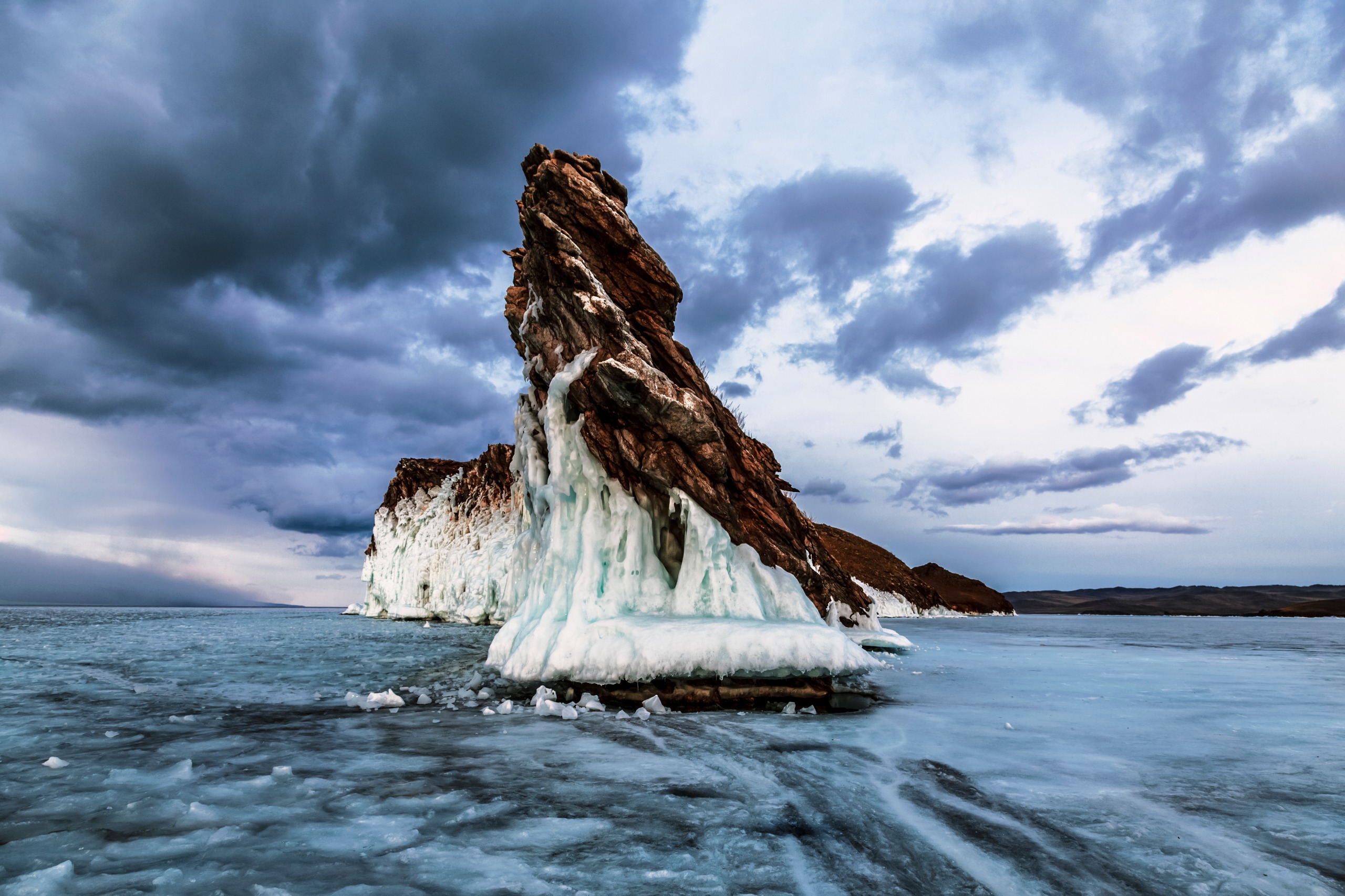
Ogoy Island
A small rocky islet in Lake Baikal, Ogoy is home to a white Buddhist stupa erected in 2005 and sweeping views across the Maloe More strait. Accessible by boat in summer, across the ice in winter.
Ogoy Island is a small rocky islet located in Maloe More bay, northwest of Olkhon Island, in Lake Baikal. Stretching some 3 km in length, it is renowned for the white Buddhist stupa that crowns its summit, erected in 2005 and visible from afar across the frozen lake or from the shores of Olkhon. The site blends Buddhist spirituality with raw Siberian landscape, drawing both pilgrims and hikers.
Quick Facts
- Access: by boat from Khoujir (Olkhon) in summer; on foot or by vehicle across the ice in winter (depending on conditions).
- Suggested duration: half day, including the crossing and climb to the stupa.
- Attire: warm clothing essential, even in summer — wind across the lake is brisk.
- Rules: respect the stupa's perimeter; do not leave offerings that fall outside traditional practice.
What to See
The white Buddhist stupa dominates the island's highest point. It was consecrated in 2005 by Buryat lamas and contains sacred relics and texts. Colorful prayer flags flutter in the wind around it. The rest of the island is covered in steppe and rock, with no dense vegetation. Views of Lake Baikal and Olkhon's cliffs stretch unobstructed in all directions.
History and Context
Ogoy is regarded as a sacred place within Buryat shamanic tradition long before the stupa's construction. The erection of this Buddhist monument in 2005 layered two spiritual traditions upon the same ground. The stupa was built according to Tibetan canon, with the blessing of Buddhist masters. Today, the island remains a quiet pilgrimage site, frequented by practitioners of both traditions.
Highlights of Your Visit
The Stupa and Its Prayer Flags
The climb to the stupa takes about twenty minutes from the landing point. At the summit, lungta prayer flags frame the white monument. Tradition holds that one should circumambulate it clockwise (kora) while holding an intention.
Panorama Over Maloe More
From the summit, your gaze sweeps across the Maloe More strait, Olkhon's hills to the east, and mountains on Lake Baikal's western shore. In winter, the expanse of blue, cracked ice renders the landscape particularly striking.
Winter Ice Crossing
Between January and March, the lake freezes thick enough to reach Ogoy on foot or by all-terrain vehicle. The transparent ice sometimes reveals several meters of depth beneath. This crossing is among the most memorable experiences of Baikal in winter.
Etiquette and Visiting Rules
- Circumambulate the stupa in a clockwise direction.
- Do not climb on the stupa or touch the relics.
- Avoid loud behavior near the monument.
- Leave no litter on the island — no collection infrastructure is present.
Photography Tips
Morning light, when the sun rises behind Olkhon, illuminates the white stupa frontally. In winter, the contrast between blue ice and the white monument is highly photogenic from the island's lower reaches. Prayer flags in the foreground with the lake beyond make for the classic composition of this place.
Location and Access
Ogoy lies within Maloe More strait, just a few kilometers northwest of Khoujir, Olkhon's main village. In summer, boat excursions depart regularly from Khoujir. In winter, organized tours in UAZ (Russian 4×4s) cross the ice. The island itself slopes gently at its base and moderately toward the summit; the climb to the stupa is manageable for most able-bodied visitors.
In the Surrounding Area
- Cape Burkhan (Shaman Rock) — Olkhon's emblematic shamanic site, with caves and marble cliffs.
- Cape Khoboy — the northern tip of Olkhon, renowned for its ice columns in winter and views of open Baikal.
- Khoujir Village — the main hub on Olkhon, with accommodations and the departure point for excursions.
Frequently asked questions
In summer, boat excursions depart from Khoujir. In winter (January to March), the crossing is made across the lake ice, on foot or by all-terrain vehicle depending on ice thickness.
Winter (February to March) offers the spectacle of Lake Baikal's frozen surface and exceptionally clear light. Summer (July to August) permits comfortable boat crossings and long daylight hours.
No religious dress code is imposed, but respectful conduct is expected. Warm clothing and sturdy hiking shoes are essential regardless of season.
Yes. Most boat excursions from Khoujir include Ogoy in a circuit that also visits other islets or Cape Khoboy. In a single day, you can see several sites.
It depends on conditions that year. It is strongly advised to use a local guide or agency that assesses ice thickness before each outing. Never cross alone without current information.
Interested in this visit?
We can include it in your personalised itinerary.