Vladimir
Vladimir
Capital of the Golden Ring, Vladimir preserves some of Russia's finest white-stone monuments. Our complete guide to visiting this 12th-century princely city.
Capital of the Golden Ring, a collection of historic and cultural destinations in Russia, Vladimir is a charming city with a glorious past reflected in its historic monuments. This ancient princely city, which reached its golden age in the 12th century, houses some of the country's most beautiful structures. Moreover, its proximity to the capital makes it an essential destination when traveling to Russia.
A Glimpse into History
The history of Vladimir predates that of Moscow and most Russian cities. From this perspective, it can be considered the mother of Russian cities. This ancient city was founded in 1108 when Emperor Vladimir Vsevolodovitch, better known as Vladimir II Monomakh, built a fortress here to defend the southeastern part of the country. From this stronghold grew the Principality of Vladimir, ruled by Vladimir Vsevolodovitch, nicknamed "Yuri Dolgoruky."
Vladimir was a genuine construction site where imposing monuments rose from the ground daily. Quickly, it rose to the same rank as Kiev, capital of the Grand Princes of the era, in terms of power and architecture—so much so that Yuri Vladimirovich transferred the capital from Kiev to Vladimir. It held this status for approximately two centuries, during which it continuously developed and prospered.
But this growth was interrupted by the invasion of the Turks and Mongols in the 13th century, during which the new princely city was burned and plundered of its riches. This invasion not only affected the city's economy but also cost Vladimir its political importance, with Moscow rising to replace it as the country's capital.
Discovering Vladimir
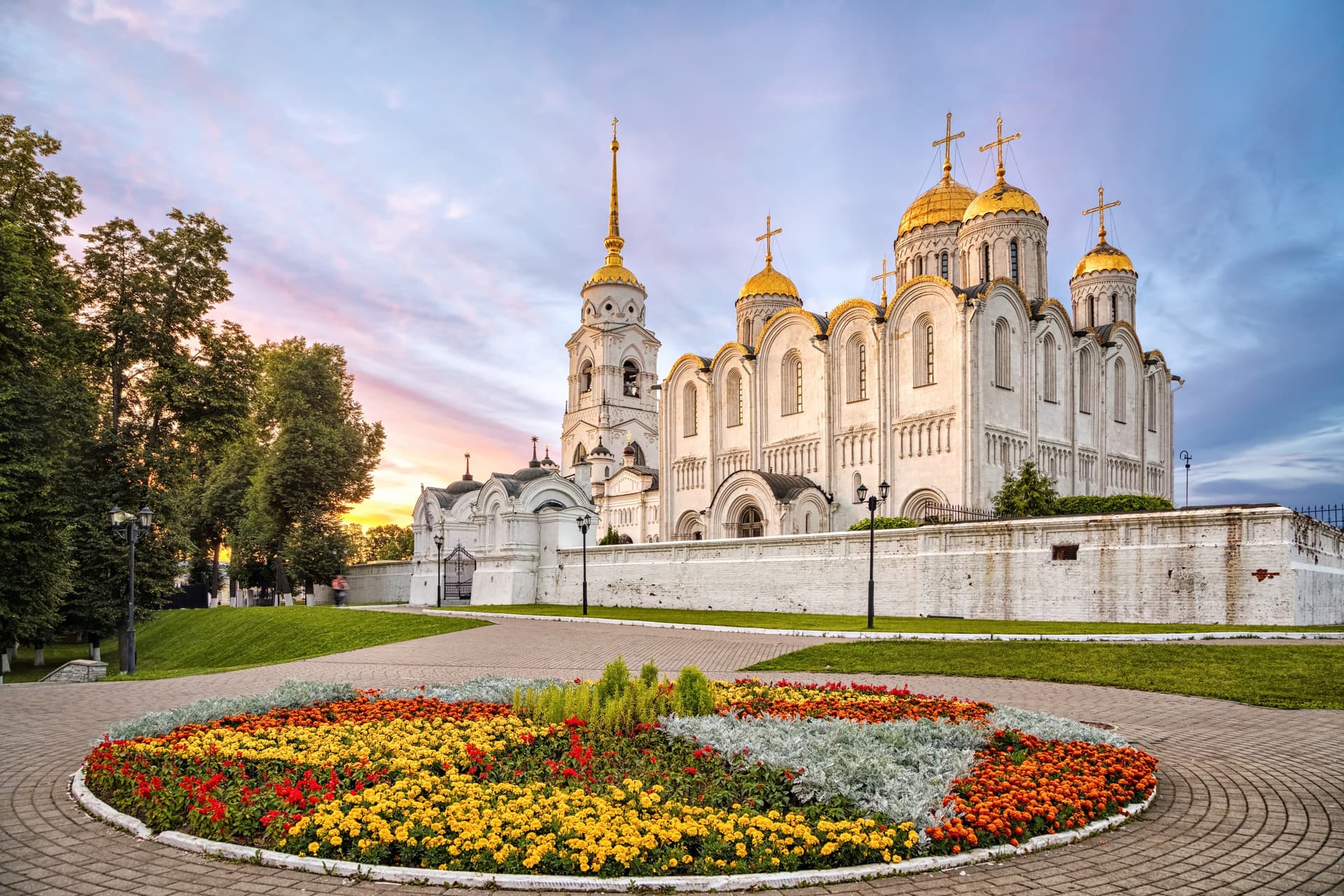
Although today, the city of Vladimir is universally recognized as the capital of the Golden Ring (a collection of historically and culturally rich destinations in Russia), it remains an ordinary city housing some historic monuments inherited from its glorious past. The most important of these is undoubtedly the Cathedral of the Assumption, renowned for its exceptional frescoes. Rebuilt several times during its long existence, its architecture bears the marks of different Russian architects from the 13th to the 19th centuries.
Another building worth visiting is St. Dmitri Cathedral, built in 1197. Despite its relatively simple architecture (a cathedral topped with a single dome), its forms are harmoniously distributed and convey nobility. Indeed, it was built for the princely court under the direction of Vsevolod III, also known as "Vsevolod the Great Nest."
Beyond the cathedrals, Vladimir is also famous for its Golden Gate, a remarkable structure and remnant of the city's ramparts, now long gone. This monument, built in 1164, is inscribed on the UNESCO World Heritage List. It was the city's main entrance in the 12th and 13th centuries, giving access to the city's wealthiest quarter. Today under the administration of the Vladimir-Suzdal Museum-Conservatory of History, Arts and Architecture, the Golden Gate houses an exhibition hall featuring an exhibition on military history.
The Best Time to Visit
The best time to visit Vladimir is during summer. Despite this summer season, with Russia's continental climate, temperatures can drop to around 10°C. Be sure to pack some warm clothing.
By Car
To drive to Vladimir from Moscow, simply take the Vladimir Road, known as Vladimirka, the only road connecting these two destinations separated by approximately 190 kilometers.
By Train
It is also possible to reach Vladimir by train from the capital. You even have a choice between the modern high-speed train and the suburban train, which takes longer to arrive at your destination.
Want to discover this destination?
Our local advisors design your tailor-made trip.