Ulan-Ude
Ulan-Ude
Between a colossal Lenin head, Buddhist monasteries, and Buryat culture, Ulan-Ude stands as the most exotic stop on the Trans-Siberian Railway.
Situated deep in the heart of Siberia, Ulan-Ude is a metropolis where the most contradictory cultures and ideologies collide. This former Soviet outpost is renowned for housing one of the most striking architectural works of that era: the world's largest statue of Vladimir Lenin's head—and also home to Russia's unique Buddhist temple dedicated exclusively to women, the Datsan Darjaling Zungon. A must-see destination in Russia, the capital of the Buryat Republic positions itself as an unmissable stop for enthusiasts of Soviet history and culture.
A Brief History
Ulan-Ude was founded in 1666 by Russian Cossacks. Initially, it was merely a simple military outpost. Over time, however, it developed into one of the most important cities in Buryatia. Throughout its history, it has borne various names—Udinsky Ostrog and Verkhnye-Udinsk among them. It wasn't until 1934 that it was renamed "Ulan-Ude," meaning "red gate" in the Buryat language, a designation reflecting Soviet communist ideology.
Like most Russian cities, the arrival of the Trans-Siberian Railway in Ulan-Ude in 1903 contributed enormously to the city's development, both economically and socially. Indeed, just two decades later, Ulan-Ude was elevated to the status of capital of the Buryat Autonomous Republic.
Exploring Ulan-Ude
Today, beyond being the capital of the Buryat Republic, Ulan-Ude is also the most populous city in the region, with over 430,000 inhabitants as of 2016. While the majority of the population is Russian, the city is home to peoples from various neighboring areas who have settled here, creating an exceptional cultural tapestry.
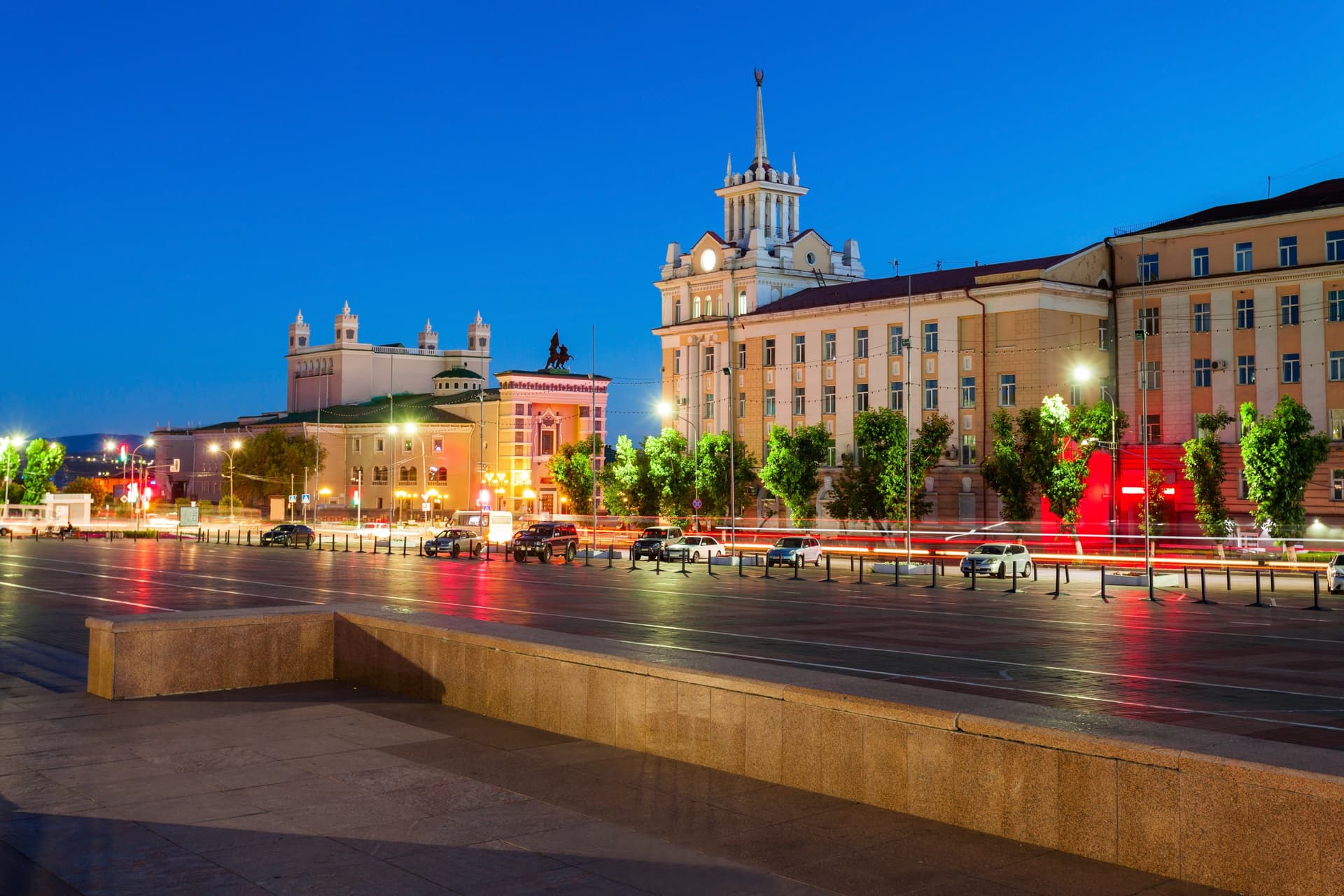
A visit to the city typically begins with its historic center. Like most Russian cities, Ulan-Ude boasts a historic quarter that time seems to have forgotten. Rows of merchants' houses adorned with ornate wooden and stone carvings transport visitors back to the splendid imperial era of the 19th century.
Ulan-Ude is also home to roughly a dozen museums, including the renowned Transbaikal Ethnographic Museum. This institution is celebrated for its ambitious recreation of Siberia's past—spanning from the 3rd century to the early 20th century—through its 11,000 artifacts and 40 architectural monuments. The site is easily accessible, located just 10 km from Ulan-Ude in the Verkhniaïa Berezovka district. You can reach it by shared taxi, public transport, or regular taxi. The museum is open daily until 6 p.m. on weekdays and until 8 p.m. on weekends.
This metropolis is equally renowned for its Buddhist temples, such as the Datsan Ivolguinski, nothing less than Russia's most significant Buddhist monastery. It stands about twenty kilometers from the city, nestled in magnificent wild steppe. Beyond Datsan Ivolguinski, Ulan-Ude also houses Russia's only Buddhist temple dedicated to women. This is the Datsan Darjaling Zungon. This sanctuary, in fact, reflects a celebrated Buryat myth asserting that the ancestor of all earthly inhabitants was a woman. The temple is situated 5 km from the city center, in district no. 18.
As a former Soviet military outpost, Ulan-Ude hosts one of the era's most striking architectural achievements: a colossal statue of the Bolshevik revolutionary leader Vladimir Lenin's head. Its sheer scale earned it a place in the Guinness World Records.
Best Time to Visit
Ulan-Ude enjoys a subarctic climate characterized by dramatic temperature swings—hot summers contrasted with brutally cold winters. July is the warmest month, while January is the coldest, with temperatures dropping as low as −20° C.
Ulan-Ude has an airport accommodating domestic and regional flights.
Train travel is also an option. The city has been served by the Trans-Siberian Railway since 1903.
Want to discover this destination?
Our local advisors design your tailor-made trip.