Orthodox Christmas and New Year in Russia
Before anything else, it's important to know that Russia once followed the Julian calendar, but from 1918 onwards (after the revolution), the country began to adopt the Gregorian calendar. Nevertheless,
Before anything else, it's important to know that Russia once followed the Julian calendar, but from 1918 onwards (after the revolution), the country began to adopt the Gregorian calendar. Nevertheless, the Russian clergy decided to maintain the old calendar.
Orthodox Christmas and Orthodox New Year remain the principal traditional celebrations in Russia. Moreover, the dates of their commemoration still follow the Julian calendar.
Orthodox Christmas in Russia
According to the Julian calendar, the birth of Christ (and therefore the Christmas celebration) is observed on January 7th every year.
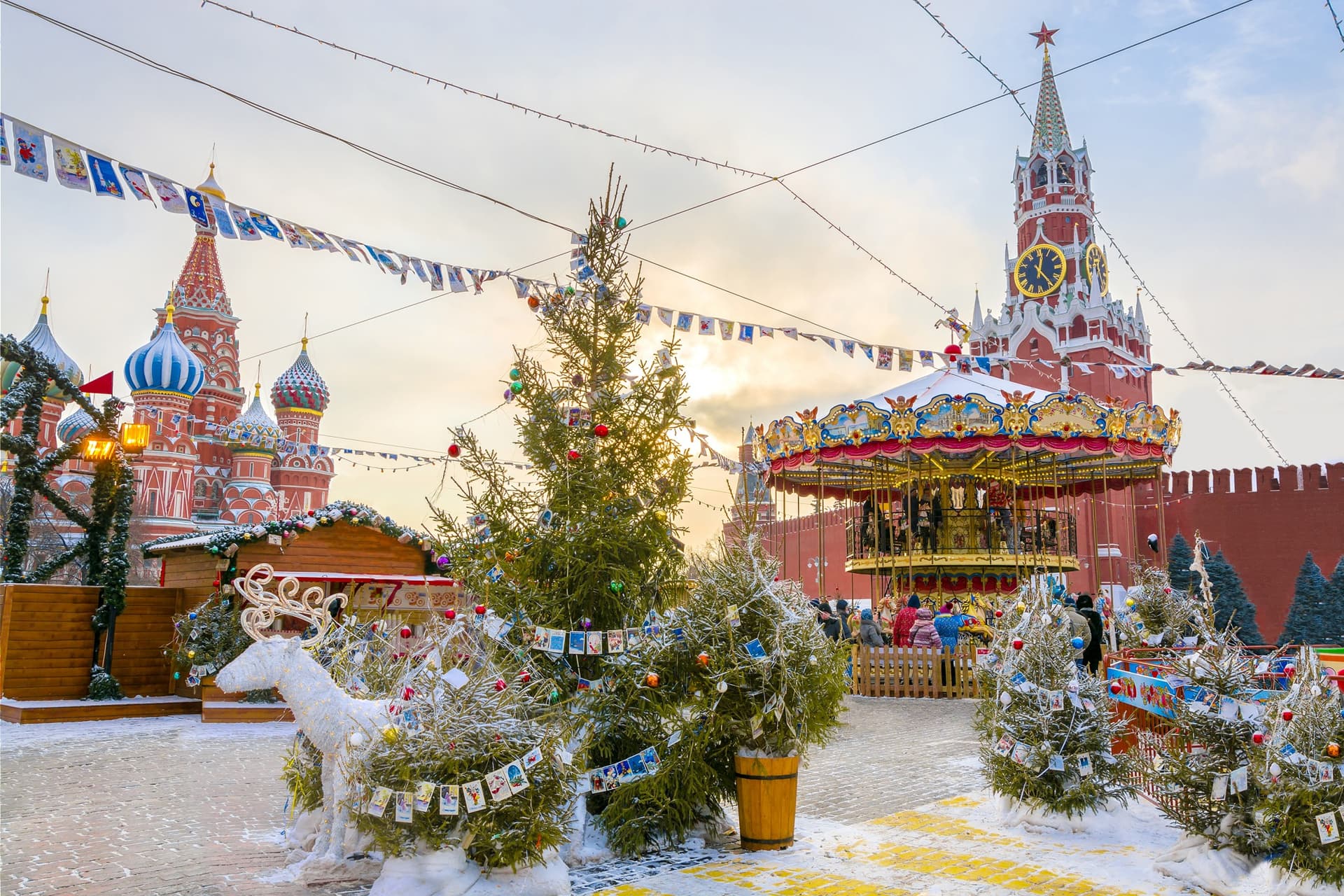
Yet what most closely resembles the Christmas celebration in Western Europe takes place on December 31st in Russia. Indeed, under Soviet rule, due to its anti-religious policies, celebrating Christmas was officially forbidden. It is from this era that the celebration of New Year gained such importance in the country.
On the night of December 31st to January 1st, it is not Father Christmas who is awaited but Ded Moroz, or Grandfather Frost. This mythical figure wears a red or blue coat trimmed with fur, sports felt boots and a hat, and bears a striking resemblance to Father Christmas. When this character makes a public appearance, he is always accompanied by a young girl named Snegourochka. She is the Snow Maiden with blonde braided hair, dressed in a glittering white or blue gown. On her head, she wears a diadem called a "kokochnik," magnificently adorned with gemstones.
These two emblematic figures of Russian Christmas are often visible during morning performances organized for children called "outrenniks."
It is also common during this period to watch old Soviet films that evoke the atmosphere of New Year.
Focus on the Old Russian New Year
Due to the day difference between the Julian and Gregorian calendars, the faithful of the Russian Orthodox Church also celebrate their own New Year, locally known as "Старый Новый год," the "Old New Year". This celebration is commemorated in both major cities and remote regions. Its observance follows the Julian calendar (thus on the night of December 31st to January 1st), but generally speaking, the Russian New Year takes place on the night of January 13th to 14th according to the Gregorian calendar (the calendar used worldwide). It should be noted that other Eastern European countries such as Ukraine, Belarus, and Georgia also celebrate the Orthodox Old New Year.