Kazan and the Volga
Tatar Kazan, its UNESCO kremlin where mosque and cathedral face one another, then the descent of the Volga to Astrakhan via Samara and Volgograd.
Kazan sits at the confluence of the Volga and Kazanka rivers, 800 kilometers east of Moscow. Capital of the Republic of Tatarstan, an autonomous republic within the Russian Federation, the city is home to 1.3 million inhabitants divided almost equally between Muslim Tatars and Orthodox Russians. This religious and linguistic duality shapes daily life: bilingual signage in Russian and Tatar, calls to prayer answering church bells, confessional schools of both traditions. Our team based in the capital arranges transfers from Moscow by overnight train, twelve hours in a sleeper cabin, or by plane, one and a half hours to Kazan airport.
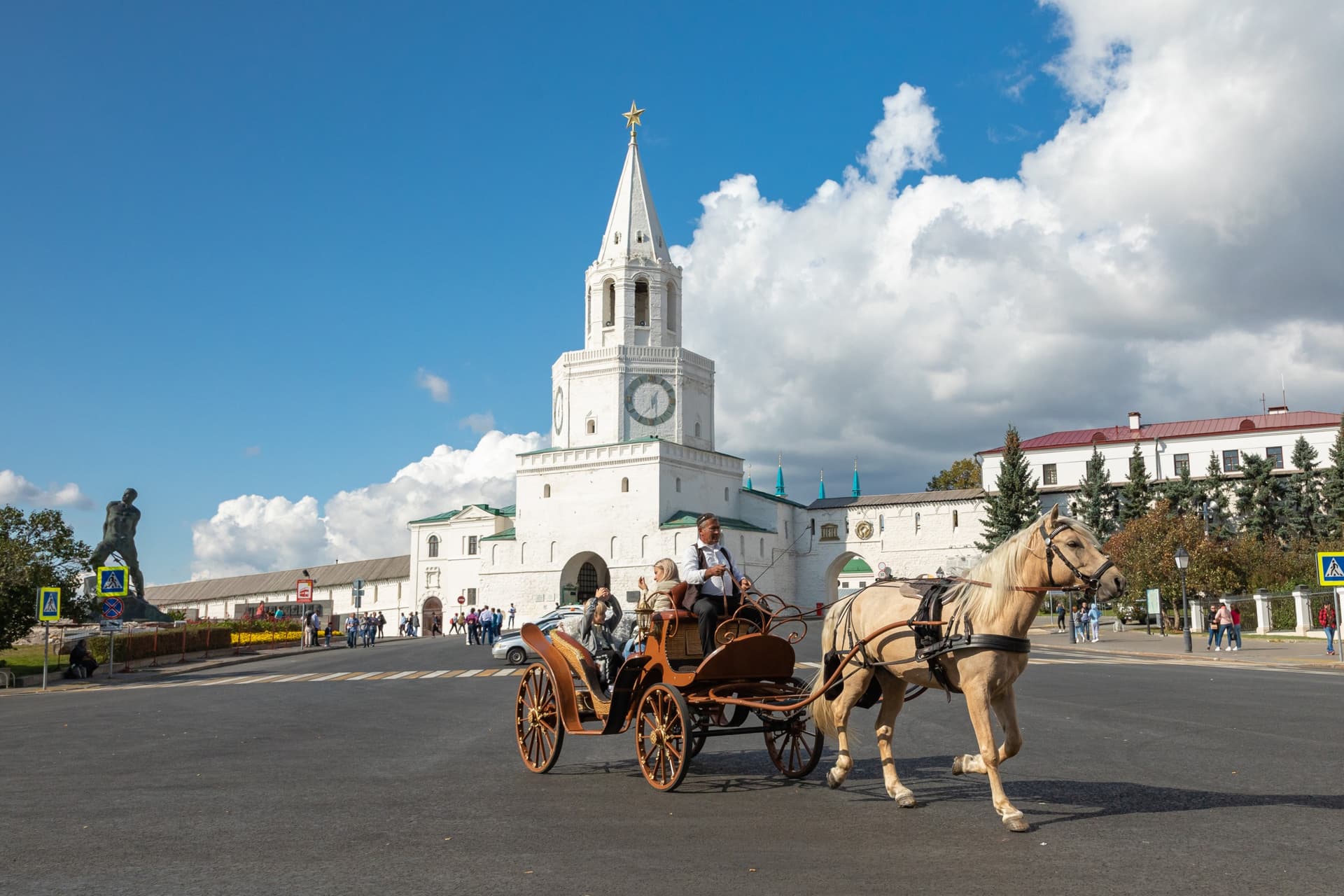
Kazan's kremlin, a UNESCO World Heritage site since 2000, occupies a hill overlooking the left bank of the Volga. Within the white walls, the Kul Sharif Mosque, reconstructed in 2005, and the Cathedral of the Annunciation from the 16th century face each other on the same esplanade. It is one of the rare ensembles where one moves without transition between two worlds. The leaning tower of Söyembikä, 58 meters of red brick, marks the northern corner of the kremlin and holds strong symbolic significance for Tatars: it recalls Ivan the Terrible's capture of Kazan in 1552.
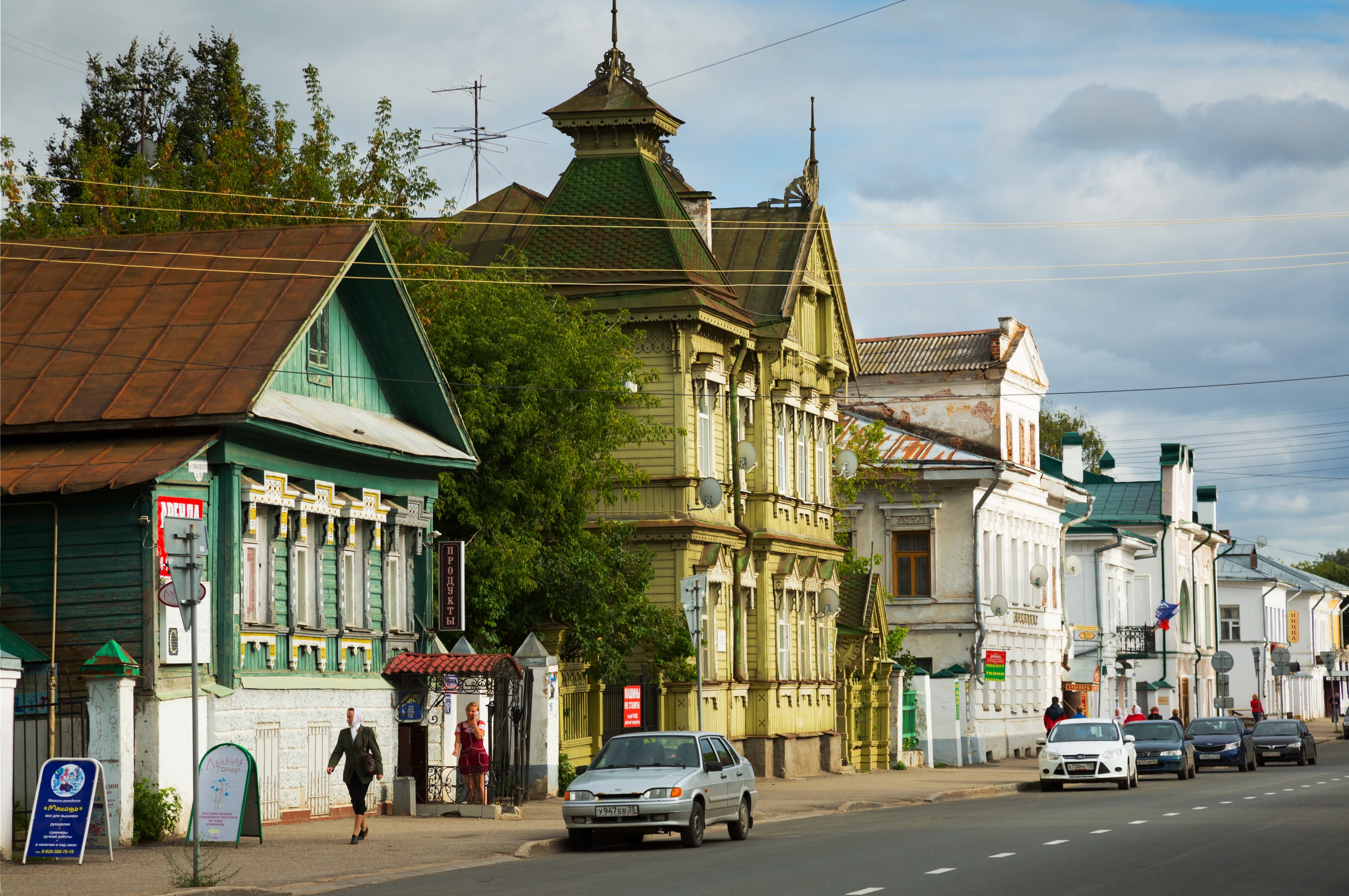
Tatar cuisine deserves a chapter of its own. Echpochmak—triangular pastries filled with lamb and potatoes—are eaten as a snack at any hour. Chak-chak, fried dough bound with honey, accompanies black tea served in samovars. We regularly take our guests to Bauman Market and the tea houses in the Tatar quarter of Staro-Tatarskaya Sloboda, below Lake Kaban, where the painted wooden houses of 19th-century Muslim merchants still stand.
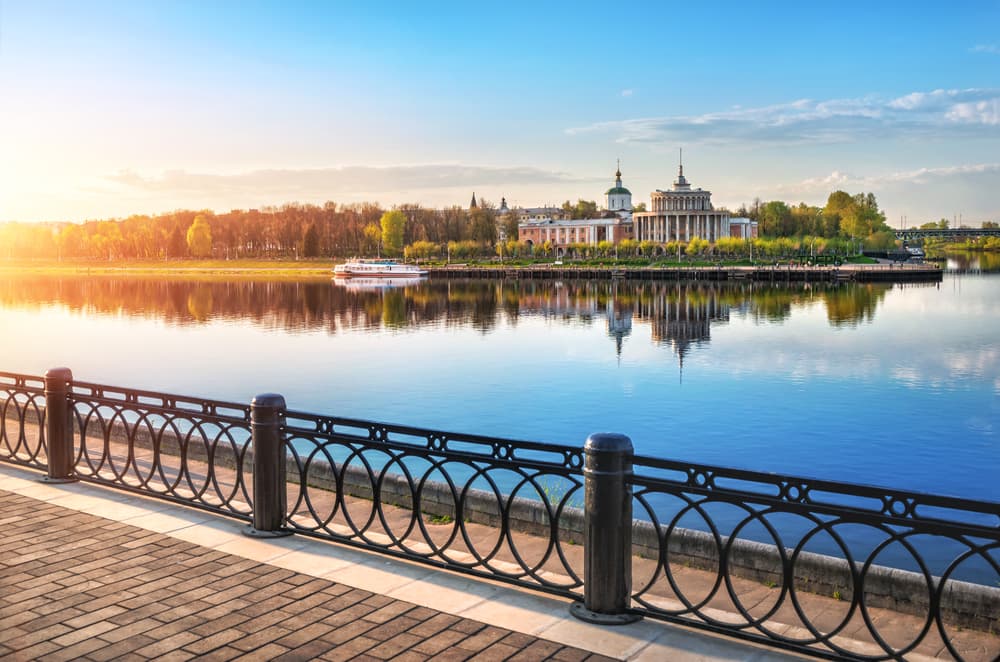
The Volga, Europe's longest river at 3,530 kilometers, structures the country's eastern half. From Kazan, one can descend the river to Astrakhan in seven to ten days of river cruising, with stops at Ulyanovsk, birthplace of Lenin; Samara; Saratov; and Volgograd, the former Stalingrad. On Mamaev Kurgan hill in Volgograd, the statue of the Motherland looms—a reinforced concrete sculpture 85 meters tall, completed in 1967—commemorating the battle that claimed two million victims between 1942 and 1943. Navigation remains possible from mid-May to late September, as the river freezes over in winter in its northern reaches.
Further downstream, the landscape changes dramatically. After Volgograd, the Volga forms a delta of 19,000 square kilometers before emptying into the Caspian Sea. Astrakhan, former capital of a Tatar khanate conquered in 1556, retains a white kremlin and a fish market where farmed sturgeon is still sold. Lotus fields bloom in July and August on the delta's secondary channels. This southern extremity offers a dry, warm climate, very different from the mixed forests of Tatarstan.
Beyond cruise tourism, the Volga region remains seldom visited by English-speaking travelers. This is precisely what we find appealing: you move through Muslim Tatar Russia, through lesser-known industrial cities like Cheboksary, capital of Chuvashia, or Yoshkar-Ola, capital of Mari El, which highlight the country's ethnic diversity. Forty peoples coexist in the Volga basin, including the Mari, Chuvash, Mordvin, and Udmurt, each with their Finno-Ugric or Turkic language.
To discover
Kazan Kremlin and Kul Sharif Mosque. The white fortifications overlooking the Volga house side by side the mosque with turquoise domes from 2005 and the 16th-century Orthodox cathedral. Visit in two to three hours, free access to the esplanade.
Kazan-Astrakhan cruise on the Volga. Seven to ten days of river descent with stops in Samara, Saratov, and Volgograd. Cabins with portholes, navigation possible from mid-May to late September.
Mamaev Kurgan in Volgograd. Memorial hill of the Battle of Stalingrad crowned by the Motherland statue, 85 meters of reinforced concrete. The commemorative avenue descends toward downtown in an hour's walk.
Tatar quarter of Staro-Tatarskaya Sloboda. Painted wooden houses from the 19th century around Lake Kaban, Marjani Mosque from 1770, tea houses where one tastes echpochmak and chak-chak in late afternoon.
Volga Delta and lotus fields. 100 kilometers south of Astrakhan, the delta's secondary channels are covered with blooming lotus flowers in July and August. Outings by motorboat from the fishing villages of Damchik or Trekhizbinka.
When to go
The practical season runs from mid-May to late September, a window that also matches river navigation on the Volga. In July and August, Kazan ranges between 22 and 28 degrees during the day, with brief thunderstorms in late afternoon. Astrakhan, further south, often exceeds 32 degrees in midsummer and receives less than 200 millimeters of rain annually, a very dry semi-arid climate. May and September offer milder temperatures, 15 to 20 degrees, and fewer crowds on cruise boats.
In winter, from December to March, the Volga freezes and temperatures in Kazan drop to minus 15 degrees or lower, sometimes minus 25 during Siberian cold waves. The city remains accessible and beautiful under snow, but river cruising is not possible then. April and October are transition months, often rainy and muddy, which we advise against unless you have a specific interest in Kazan alone.
Practical advice
For Kazan alone, allow three full days: one for the kremlin and center, one for the Tatar quarter and national museum, one for an excursion to the island-town of Sviyazhsk, founded by Ivan the Terrible 60 kilometers upstream, accessible by hydrofoil in summer. A Kazan-Astrakhan cruise requires ten to twelve days including arrival and return flights. The logistical entry point is Kazan International Airport, connected to Moscow in one and a half hours and to Istanbul nonstop. The overnight train from Moscow, twelve hours in a sleeper cabin, remains the most economical formula and the one most used by our guests.
Kazan naturally combines with Moscow and surroundings at the beginning or end of a trip, two to three hours by flight or twelve hours by train. Pairing with the Golden Ring is coherent for those who wish to compare Orthodox Russia and Tatar Russia. For a complete river logic, the cruise to Astrakhan can be extended by Russian Caucasus via a domestic flight, Mineralnye Vody being an hour from Astrakhan by plane. Hotel comfort is adequate in major cities, more rustic on cruise boats where we favor Russian companies operating renovated vessels. This region suits the traveler curious about history, cultural blends, and secondary cities, less so the hiker or lover of spectacular landscapes.