Nizhny Novgorod
Nizhny Novgorod
At the confluence of the Volga and Oka rivers, Nizhny Novgorod brings together a 16th-century Kremlin, merchant quarter streets and a vibrant cultural scene. A distinctly Russian city, away from the beaten path.
Nizhny Novgorod spreads across the confluence of the Volga and Oka rivers, roughly 400 km east of Moscow. Russia's fifth-largest city by population, it combines an intact medieval Kremlin, a 19th-century merchant old town and a lively cultural scene. Founded in 1221, it long served as the commercial capital of imperial Russie before becoming, under the name Gorky, a closed industrial and scientific hub for foreigners. Since its reopening, it has emerged as one of the country's richest urban destinations.
Quick reference
- Access from Moscow: Sapsan train from Moscow-Kursk station (approximately 3 hours 30 minutes) or domestic flights from Sheremetyevo/Domodedovo.
- Local transport: metro (5 stations on the Moskovskaya side), trams, trolleybuses and a funicular connecting the upper town to the lower town.
- Recommended duration: 2 to 3 days to cover the Kremlin, historic quarters and riverbanks.
- Dress code: covered clothing required in churches and monasteries.
- Accessibility: the Kremlin and upper town feature significant elevation changes; the funicular facilitates access between the two levels.
What to see
The city divides into two distinct levels. The upper town houses the Kremlin, major shopping streets and museums. The lower town, along the Volga and Oka, concentrates the historic Rozhdestvenskaya and Ilinskaya quarters, their carved wooden houses and converted merchant warehouses. The funicular connects the two levels in minutes.
History and context
Founded in 1221 by Prince Yuri II, Nizhny Novgorod withstood Mongol invasions thanks to its fortified position. In the 16th century, its red brick Kremlin was rebuilt under Ivan the Terrible. From the 17th to 19th centuries, the Nizhny Novgorod Fair—the largest in the Russian Empire—made it the heart of trade between Europe and Asia. Renamed Gorky from 1932 to 1990, the city closed to foreigners due to its defense industries. Academician Andrei Sakharov was exiled there from 1980 to 1986.
Highlights of your visit
The Kremlin
Thirteen towers connect the red brick ramparts that overlook the Volga. The walls enclose the Nizhny Novgorod Art Museum, the Archangel Michael Cathedral and a military memorial. A walk along the ramparts offers a panorama of the confluence of the two rivers.
Rozhdestvenskaya Street
This lower town artery lines merchant facades from the 19th century, now occupied by restaurants, galleries and bars. The Church of the Nativity (Stroganov), with its exuberant Baroque décor financed by the Stroganov family, is its architectural centerpiece.
The Ilinskaya quarter and wooden houses
Alleys around Ilinskaya Street preserve isbas adorned with painted wood sculptures. Several have been restored under the rehabilitation program launched ahead of the 2018 World Cup.
The Volga-Oka confluence
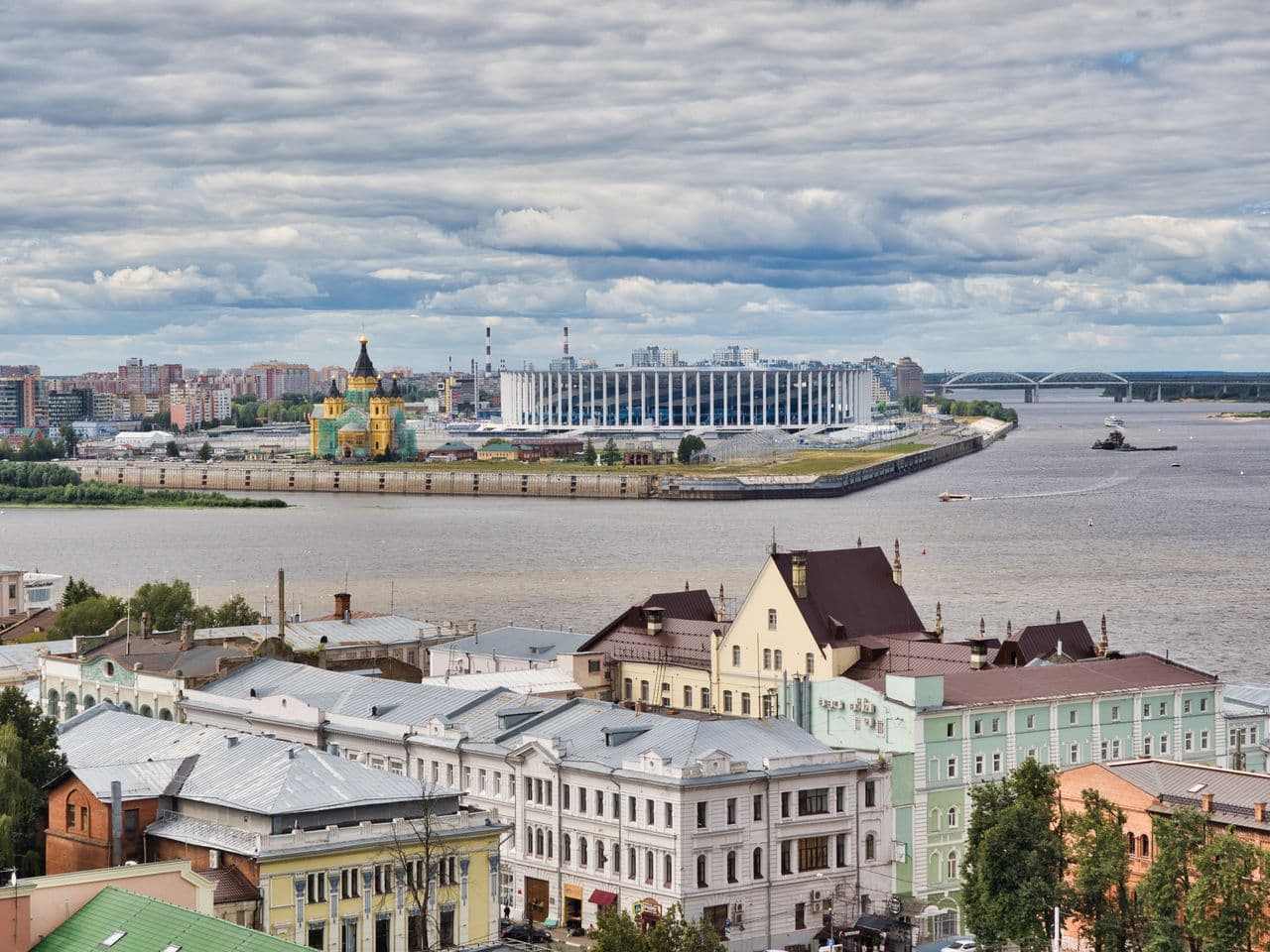
From the strelka (the point), the view of the junction of the two rivers is breathtaking. Nizhny Novgorod Stadium, built for the 2018 World Cup, occupies this peninsula. Boat trips on the Volga depart from the lower town dock in summer season.
The Nizhny Novgorod Art Museum
Located within the Kremlin, it holds a collection of Russian icons and paintings from the 18th-20th centuries, including works by Repin and Aivazovsky.
Photography tips
Sunrise from the Kremlin ramparts illuminates the Volga-Oka confluence without backlighting. Rozhdestvenskaya Street is most photogenic in late afternoon, when raking light reveals the details of façades. In winter, snow on the wooden roofs of the Ilinskaya quarter creates striking compositions. Drones require prior authorization.
Etiquette and visiting rules
- In churches and monasteries: shoulders and knees covered, head covered for women.
- Avoid photographing religious services without discretion.
- Certain areas of the Kremlin (administrative buildings) are closed to the public.
Location and access
Nizhny Novgorod is located in the oblast of the same name, on the right bank of the Volga. Strigino International Airport serves several Russian cities and some European destinations. By train, the central station (Moskovsky vokzal) is connected to Moscow by frequent trains. The metro covers the upper town; the funicular and trams supplement the network for the lower town.
Nearby places accessible as day trips: Gorodets, a craft town on the Volga renowned for its traditional painting, and Bolshoe Boldino, Pushkin's estate.
Around the area
- Gorodets — A small medieval town on the Volga, known for its wood painting and 19th-century merchant houses.
- Bolshoe Boldino — Pushkin's family estate where the poet wrote some of his major works during autumn 1830.
- Diveyevo — A major Orthodox monastery, a pilgrimage site dedicated to Saint Seraphim of Sarov.
Frequently asked questions
May through September offers pleasant weather and boat trips on the Volga are possible. Winter (December-February) offers a particular atmosphere with snow, but temperatures regularly drop below −15 °C.
Two days allow you to cover the Kremlin, Rozhdestvenskaya Street and the Ilinskaya quarter. A third day is useful for museums and a boat trip on the Volga.
The funicular (Kanatchikova) connects the two levels quickly. Monumental staircases (notably the Chkalov staircase, 560 steps) offer a sporty alternative with views of the Volga.
Yes: shoulders and knees covered for everyone, scarf for women. Some churches loan shawls at the entrance, but it's best to come prepared.
Yes. River cruises connect Nizhny Novgorod to Kazan, Yaroslavl or Moscow in summer season. Gorodets is accessible in half a day from the city.
Photography is allowed in outdoor spaces and most museums (sometimes for an additional fee). Some exhibition rooms and administrative buildings prohibit it; signs indicate this on site.
Want to discover this destination?
Our local advisors design your tailor-made trip.