Saint Petersburg
The imperial capital built by Peter the Great on the Neva, a city of baroque palaces, canals and white nights from late May to mid-July.
Saint Petersburg occupies the delta of the Neva on the eastern shores of the Gulf of Finland, 650 km northwest of Moscow. Peter the Great had the city dredged from marshland starting in 1703, with the help of Italian and French architects. The result is an imperial capital built in a single sweep, aligned along the Griboïedov Canal, the Moïka and the Fontanka, crossed by 342 bridges and organized around Nevski Prospekt, which stretches 4.5 km from the Admiralty to the Alexander Nevsky Lavra.
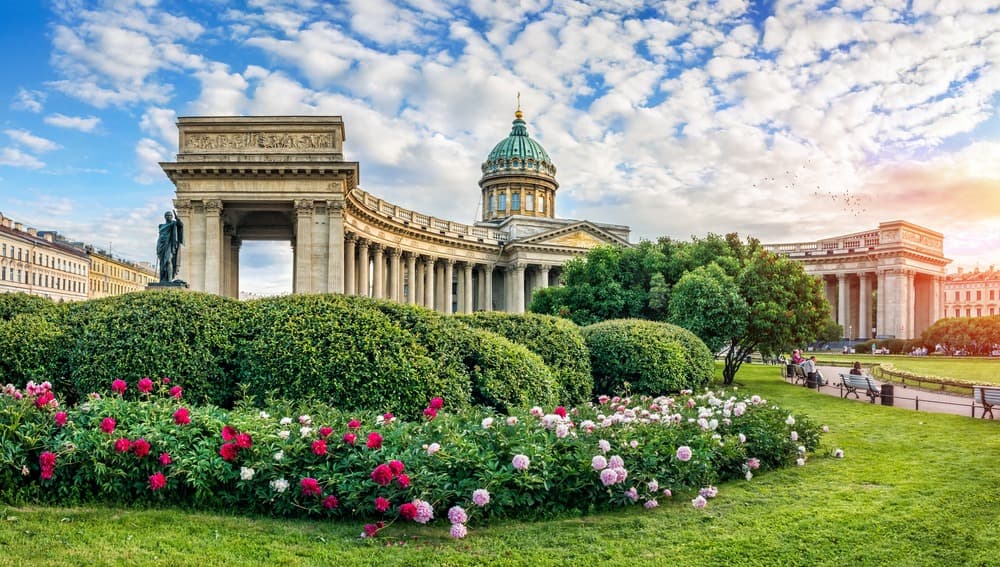
The city reads at multiple levels. On the surface, there is the baroque and neoclassical ensemble of the Stroganov, Sheremetev and Yusupov palaces, punctuated by the domes of the Church of the Saviour on Spilled Blood and the golden dome of Saint Isaac Cathedral, 101 meters high. Further on, Vasilievski Island welcomes the Stock Exchange building and the Rostral Columns, while the Peter and Paul Fortress, the city's first construction, houses the tombs of the Romanovs. The Neva reaches up to 600 meters wide in front of the Winter Palace, giving the perspective that particular sweep that Moscow lacks.
The Hermitage, former residence of the tsars, preserves approximately three million pieces distributed across five buildings including the Winter Palace. We systematically recommend planning two separate half-days: one for the Flemish and Italian schools on the first floor, one for the Impressionists and the General Staff Building. Thirty kilometers to the west, Peterhof lines up 150 fountains and the Grand Cascade descending toward the gulf; 25 km to the south, Tsarskoe Selo houses the Catherine Palace and its reconstructed Amber Room. Pavlovsk, more discreet, is worth the detour for its landscaped 600-hectare park.
The climate shapes everything. From June to August, temperatures rise to 20-23°C and the white nights illuminate the city from late May to mid-July: the sky remains milky until 2 am, and the bridges over the Neva rise around 1:30 am to let cargo ships through, cutting off access to the islands until 5 am. In winter, between December and February, it regularly drops below minus 10, sometimes minus 20, with only four to six hours of daylight, but Nevski Prospekt under snow and the skating rinks on Palace Square have their own coherence. May and September offer a compromise: 12 to 15°C, lighter crowds, still generous light.
As for food, the city cultivates a cuisine closer to the Baltic than to central Russia: marinated herrings, blini with herring or White Sea salmon caviar, fish soup ukha, Siberian pelmeni relaunched in the canteens of the Kolomna district. Vodka cellars in the Dostoevski quarter still serve assortments of zakouski (fermented gherkins, lard, marinated mushrooms) that accompany tastings. Culture is dense: the Mariinsky for opera and ballet, the Shostakovich Philharmonic, and a vibrant contemporary scene around New Holland Island, a former naval depot converted to new uses.
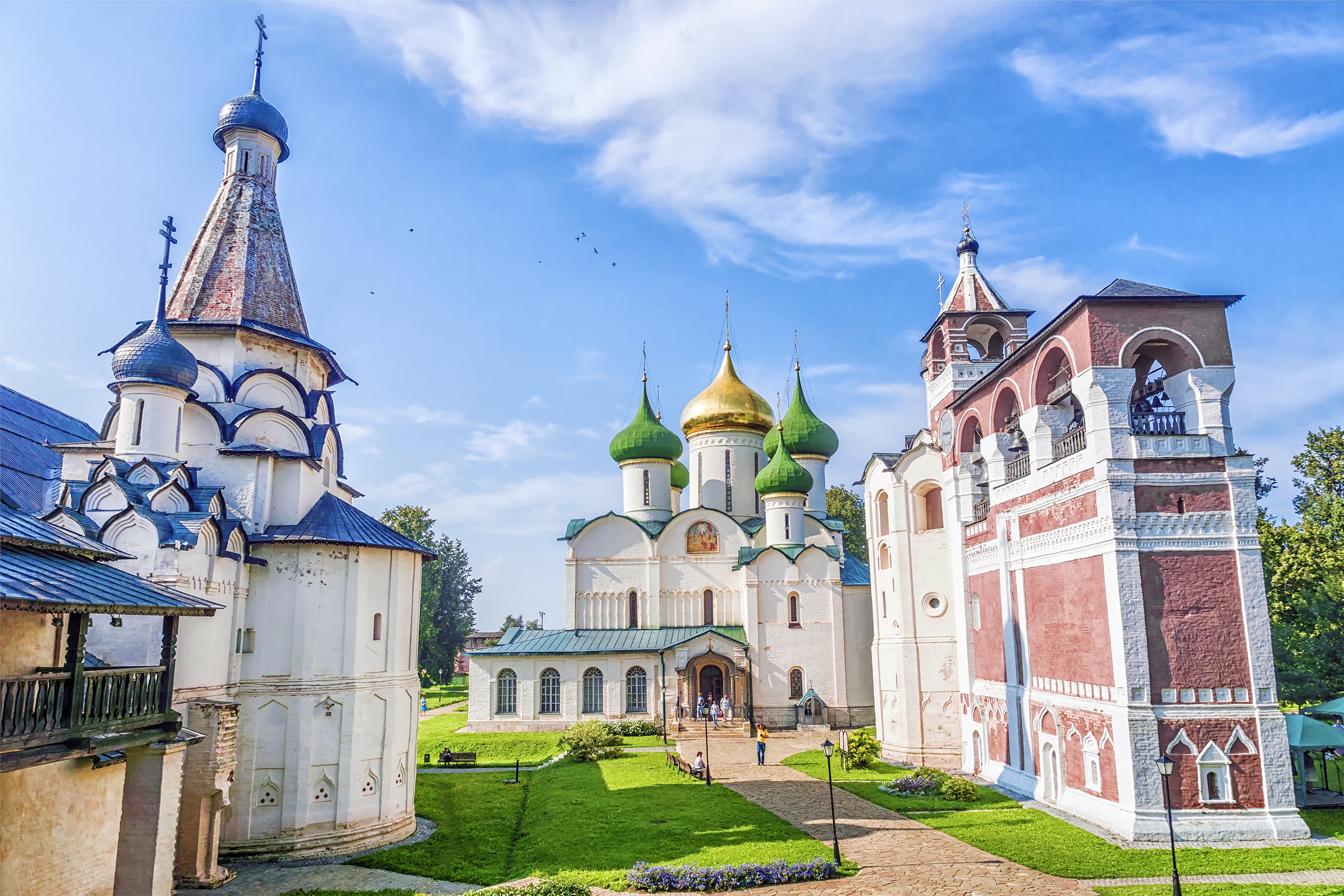
Velikiy Novgorod, three hours' drive south, preserves an 11th-century kremlin and the Cathedral of Saint Sophia from 1050, the oldest surviving religious building in Russia. We often combine the two cities to give travelers the measure of the depth of Russian history before or after the Saint Petersburg imperial episode.
To discover
The Hermitage across two visits. The Winter Palace and the General Staff Building separated by Palace Square, with a morning for the old masters and an afternoon for Matisse, Picasso and the Impressionists.
Peterhof and the Grand Cascade. A full day 30 km to the west, with its 150 fountains fed without pumps by gravity from the heights of Ropcha, and the park descending to the Gulf of Finland.
White nights on the Neva. From late May to mid-July, observe the raising of the bridges around 1:30 am from the palace quay or boats that navigate until dawn on the canals.
An evening at the Mariinsky. Ballet or opera in the historic 1860 hall or the contemporary Mariinsky II stage, to be booked two to three months in advance for the October to June season.
Velikiy Novgorod as an extension. Three hours' drive south for the 11th-century kremlin, Saint Sophia from 1050 and the churches of Yuriev on Lake Ilmen, over a day or with an overnight stay.
When to go
The widest window extends from mid-May to mid-September. June and July concentrate the white nights and temperatures of 18 to 23°C, but also maximum crowds at the Hermitage and Peterhof: we recommend early morning or late afternoon entry times. August remains pleasant around 20°C, with more frequent showers. May and September, between 10 and 15°C, suit travelers who want the palaces and museums without the crowds.
From October to March, the city shifts into another rhythm. November is the most difficult month: 3 to 5°C, rain, little snow yet, very short days. From late December to February, the cold stabilizes between minus 8 and minus 15°C, sometimes minus 20 during Siberian cold snaps, but the snow holds and the raking light on the pastel facades has real photographic interest. Outdoor skating rinks and the Mariinsky season run at full tilt. April is best avoided: thaw, muddy sidewalks, persistent gray skies.
Practical advice
We recommend a minimum of four nights in Saint Petersburg to cover the Hermitage across two visits, Peterhof or Tsarskoe Selo over a day, the historic center on foot and an evening at the Mariinsky. Five to six nights allow you to add Pavlovsk, New Holland Island and an extension to Velikiy Novgorod. Pulkovo Airport, 20 km to the south, receives direct flights from several European capitals; the Sapsan high-speed train connects Moscow in 4 hours, making the combination between the two cities very smooth.
Saint Petersburg logically combines with Moscow and the Golden Ring for a classic 10 to 14-day circuit on imperial and Orthodox history. For travelers with three weeks, we extend toward Kazan and the Volga, then Lake Baikal via the Trans-Siberian. The level of hotel comfort is high, with historic addresses on the Moïka or Nevski Prospekt. The city suits contemplatives, art and architecture enthusiasts, music lovers, and remains accessible to families provided you alternate museums and boat rides on the canals.