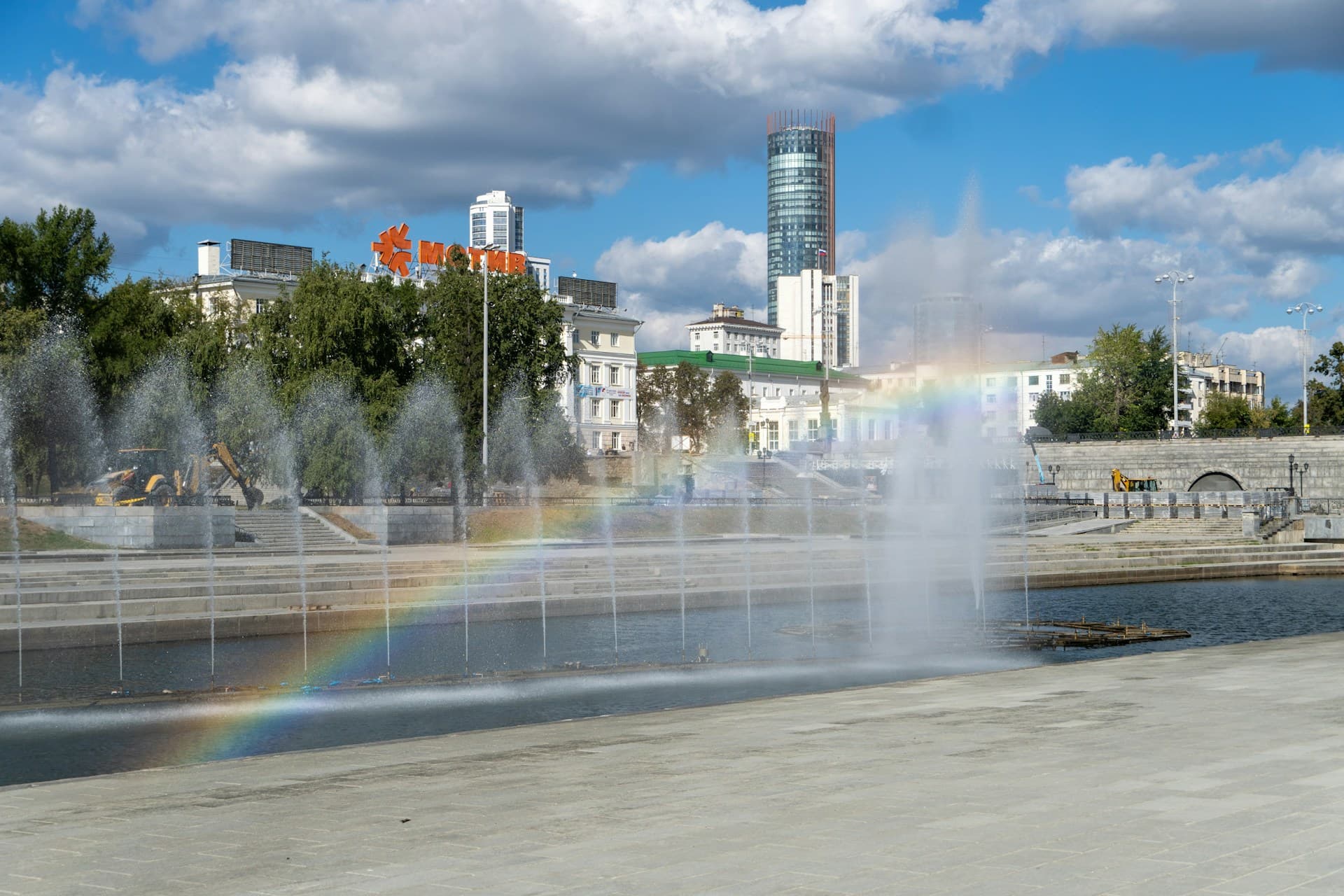
Yekaterinburg
Yekaterinburg
Yekaterinburg is Russia's fourth-largest city, capital of the Urals, positioned at the symbolic border between Europe and Asia.
Yekaterinburg is Russia's fourth-largest city, capital of the Urals, positioned at the symbolic border between Europe and Asia. Founded in 1723 as an industrial fortress, it has evolved into a major cultural, academic, and economic crossroads. The city remains inseparable from the tragic fate of the Romanovs, executed here in 1918, and attracts visitors for its Constructivist architecture, world-class museums, and vibrant artistic scene.
Key Information at a Glance
Access from Moscow: direct flight (~2 hours) or overnight train Sapsan/Ural (~26 hours on regular train, ~3.5 hours on rapid Sapsan).
Airport: Koltsovo (SVX), connected to the city center by bus and taxi.
Urban transport: metro (one line), trams, buses, and taxis.
Recommended duration: 2 to 3 days to cover the main sites.
Language: Russian is dominant; English is limited outside hotels and major museums.
Time zone: UTC+5 (2 hours ahead of Moscow).
What to See
The historic center revolves around the Iset River and the pedestrian boulevard Prospekt Lenina. It features a remarkable concentration of Constructivist architecture from the 1920s–1930s, 19th-century merchant mansions, and Soviet-era buildings. The Romanov quarter, centered on the Church on the Blood, forms a dense memorial complex. The city is also home to several major museums and a nationally recognized street art scene.
History and Context
Peter the Great ordered the founding of Yekaterinburg in 1723 to exploit the mineral wealth of the Urals. The city quickly became a metallurgical and commercial hub. In the 19th century, wealthy Ural merchants built lavish estates here. On the night of July 16–17, 1918, Tsar Nicholas II and his family were executed in the Ipatiev House, demolished in 1977. The Church on the Blood was erected on this site in 2003. During World War II, the city housed factories evacuated from the west, strengthening its heavy industry.
Highlights of Your Visit
Church on the Blood
Built at the exact site of the Romanovs' execution, this Orthodox church with five gilded domes is the city's most visited memorial site. The interior features frescoes depicting the life and martyrdom of the imperial family. An underground museum documents the final days of the Romanovs.
Ural History Museum (UOLE)
One of Russia's oldest museums, founded in 1870. Its collections span geology, ethnography, and the Urals' industrial heritage, with specimens of precious and semi-precious stones mined from the region.
Constructivist Architecture
Yekaterinburg boasts one of Russia's best-preserved ensembles of Constructivist buildings. The Gorodok Chekistov (Chekists' Quarter), the Regional Council building, and several workers' clubs from the 1920s–1930s form a coherent architectural circuit, prized by Soviet urbanism enthusiasts.
Europe-Asia Border
About twenty kilometers from the city center, an obelisk marks the symbolic border between the two continents. This site, accessible by taxi or organized tour, is an obligatory stop for travelers wishing to stand with one foot on each continent.
Weiner Street and Street Art
The pedestrian boulevard Weiner concentrates shops and cafés. Adjacent quarters feature large-scale murals created during an annual festival that has earned the city an artistic reputation well beyond the Urals.
Photography Tips
The gilded domes of the Church on the Blood are best captured in late afternoon, with raking light from the southwest.
Gorodok Chekistov photographs beautifully in early morning, before parked cars clutter the façades.
Street art murals in the Lenina quarter are accessible all day; diffuse light on overcast days avoids harsh shadows.
Inside Orthodox churches, ask permission before photographing; flash is generally prohibited.
Location and Access
Yekaterinburg is situated in the oblast of the same name, approximately 1,400 km east of Moscow. The city center is compact and partially pedestrianized. The metro serves the main thoroughfares; trams extend the network to outlying neighborhoods. Major historical sites cluster within a 2 km radius around Prospekt Lenina, accessible on foot.
Nearby Attractions
Ganina Yama — monastery erected at the site where the Romanovs' remains were disposed; about 15 km from the city center.
Nevyansk — historic Ural city with its 18th-century leaning tower, about 80 km to the north.
Ural Natural Park — hiking in the Ural Mountains, accessible as a day excursion from the city.
Frequently Asked Questions
Frequently asked questions
May to September offers pleasant temperatures (15–25 °C) and long daylight hours. Winter (November–March) is harsh, with temperatures dropping below -20 °C, but the city remains lively and all sites stay open.
Yes. As in any Russian Orthodox church, women must cover their heads and shoulders; men remove their hats. Headscarves are sometimes available at the entrance.
Yes. The city fits naturally on the Trans-Siberian route between Moscow and Novosibirsk. It can also be combined with Kazan (approximately 1,000 km to the west) via overnight train.
International hotels and major museums have English-speaking staff. In public transport and everyday shops, Russian is essential; an offline translation app is highly recommended.
Two days allow you to cover the main sites (Church on the Blood, museums, Constructivist architecture). A third day is useful for an excursion to Ganina Yama or the Europe-Asia border.
The pedestrian center is generally flat. The metro has some adapted access points, but accessibility varies by site. It is advisable to verify on a case-by-case basis with museums.
Want to discover this destination?
Our local advisors design your tailor-made trip.